
The Meme Economy Timing Signal: How Kyla Scanlon May Have Spotted the Next Cycle
September 30, 2025·10 comments
In Kyla Scanlon's recent piece, "How AI, Healthcare, and Labubu Became the American Economy" she made a striking observation about how economic exclusion drives speculative behavior. We took a look at her insight through the Perscient database and found something remarkable - our data reveals a consistent pattern where "young Americans shut out" narratives reliably predict "degenerate economy" stories by several months.
What follows is how Kyla's pulse-reading on meme coins and mystery boxes reveals a predictive framework that mainstream narratives consistently miss.
1. The Meme Economy Timing Signal
Memecoins and mystery boxes are a way for people to feel they are participating in the boom, even as they are priced out of its tangible rewards. When you feel shut out of institutions, you buy meme coins that turn financial nihilism into a form of cultural expression.
The timing of this observation is nuanced, and our Perscient data reveals a fascinating pattern I at least hadn’t really seen or thought of before. Any time we get a big "young Americans shut out" trend, it's consistently followed by "degenerate economy" narratives. Con-sis-tent-ly. Gears on a clock (or a bike) style. The chart shows a massive degen economy spike in 2021, followed by young Americans exclusion stories in 2024. And if you look close, you’ll see that both narratives are currently depressed, but well off the bottom lately(!).
.png&w=3840&q=100)
What Kyla is sensing - tracking a pulse separately from broader mainstream and social media lenses, ahem - could signal the beginning of the next cycle. The media ping-pongs between "the Youth is being screwed over" and "the Youth are a bunch of degens," but our data shows this isn't random. There's a predictable sequence here: exclusion stories build first, then speculative behavior gets labeled as degeneracy months later.
These charts are starting to bounce back, so watch for the pattern to play out again. Exclusion stories will lead degen economy stories, because this is a media engagement playbook at this point.
2. The Healthcare Job Dependency Cycle
With 75% of new jobs in healthcare and social assistance, our workforce is being absorbed by the essential but underfunded 'maintenance economy' of an aging population.
This connects to the broader exclusion theme. Our Perscient data shows healthcare job dependency narratives peaked during COVID (2020) and again during the GLP-1 surge (2024), but rather than fading, they're morphing higher again. It may not predict another spike, but there are structural forces within the labor statistics that are keeping these conditions in play. This keeps a rising story ripe for a spike, making for a sectoral employment trend and story worth tracking.
.png&w=3840&q=100)
When traditional wealth-building paths get absorbed into maintenance work, it amplifies the exclusion pressures that drive people toward speculative alternatives. Kyla is identifying how demographic inevitability creates the conditions for repeated meme economy cycles. Seeing how it correlates with - if not stems from - labor and employment trends is fascinating. This becomes especially relevant in a sideways market or downturn, because consumption drives the economy, these are the jobs to really watch now.
3. The Broken Gears Reality Check
The US economy is sort of like that bike. It's moving, but its gearing system is completely out of whack. The US is operating with 3 broken gears that no longer connect.
Our Perscient data reveals that concerns about America's economy becoming concentrated peaked in mid-2024, but rather than disappearing, they're also morphing into something more nuanced. The narrative is evolving from recessionary crisis fears toward stagflationary reality acceptance - which is exactly the kind of "broken but still moving" dynamic that creates space for meme economy participation.
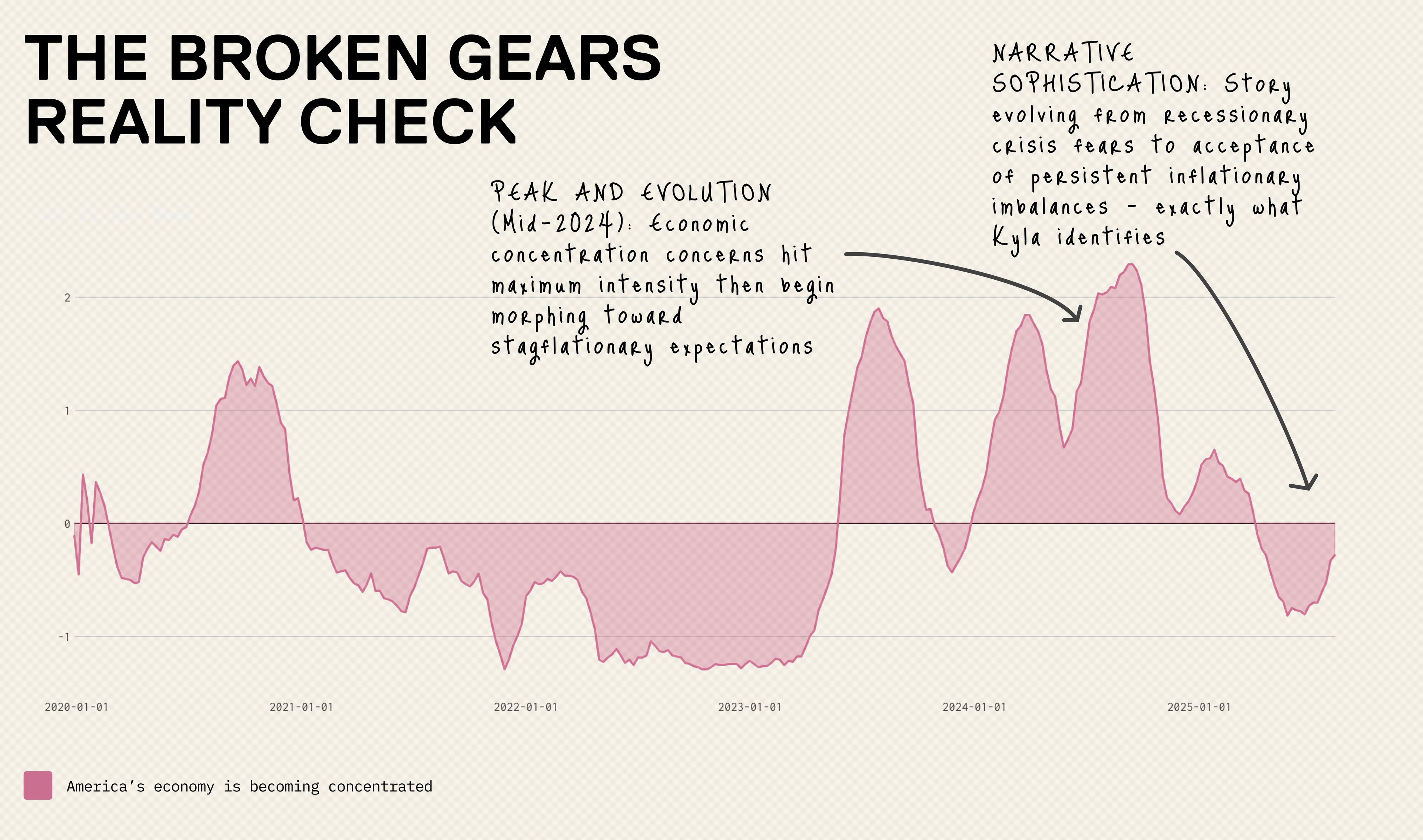
What we're witnessing isn't the end of fragmentation concerns, but their evolution toward understanding that "broken" doesn't necessarily mean recession. It means ongoing inefficiencies that price people out of traditional participation while keeping the system moving - the perfect conditions for the exclusion-to-speculation cycle Kyla identifies. And as for concentration concerns, they are turning up again - but off the lows is a long way from a peak reading still.
It’s probably obvious by this point - but what makes this analysis so valuable is that Kyla spotted a predictive pattern that our data confirms works fairly consistently. Yes, the magnitude adjusts, but this-follows-that cycling (bike bonus points, maybe?) is a notation worth making. The meme economy isn't random youth behavior - it's a measurable response to measurable exclusion that follows a reliable timeline. Understanding when the next cycle starts gives you months of advance notice on significant cultural and financial trends.
Read Kyla's full piece at her Substack for the complete Three Americas framework.
Charts powered by Perscient - tracking narratives in real-time so you can see reality before the story catches up.
https://kyla.substack.com/p/how-ai-healthcare-and-labubu-became
DISCLOSURES
This commentary is being provided to you as general information only and should not be taken as investment advice. The opinions expressed in these materials represent the personal views of the author(s). It is not investment research or a research recommendation, as it does not constitute substantive research or analysis. Any action that you take as a result of information contained in this document is ultimately your responsibility. Epsilon Theory will not accept liability for any loss or damage, including without limitation to any loss of profit, which may arise directly or indirectly from use of or reliance on such information. Consult your investment advisor before making any investment decisions. It must be noted, that no one can accurately predict the future of the market with certainty or guarantee future investment performance. Past performance is not a guarantee of future results.
Statements in this communication are forward-looking statements. The forward-looking statements and other views expressed herein are as of the date of this publication. Actual future results or occurrences may differ significantly from those anticipated in any forward-looking statements, and there is no guarantee that any predictions will come to pass. The views expressed herein are subject to change at any time, due to numerous market and other factors. Epsilon Theory disclaims any obligation to update publicly or revise any forward-looking statements or views expressed herein. This information is neither an offer to sell nor a solicitation of any offer to buy any securities. This commentary has been prepared without regard to the individual financial circumstances and objectives of persons who receive it. Epsilon Theory recommends that investors independently evaluate particular investments and strategies, and encourages investors to seek the advice of a financial advisor. The appropriateness of a particular investment or strategy will depend on an investor's individual circumstances and objectives.

Comments
I would appreciate the insight so much more if it weren’t so deeply depressing. As an unfortunate frequenter of WallStreetBets I must confirm that the embrace of the degen economy is as strong as ever, with no signs of stopping (after all, there’s always someone inheriting a little money from nana every day).
In hindsight didn’t he just make money on that trade finally? And looks like it wont be stopping.
I’m absolutely blown away by this. Brilliant analysis. Just so good, and useful… on so many levels…
This is a terrific analysis (and I’ve done my part to publicize by re-stacking. Alas, I only have about 10 followers).
I followed some of Kyla’s links about energy, and thought others might be interested in this Icelandic geothermal power plant: ON – Sjálfbær orka og betri kjör fyrir heimilið þitt . IIRC, this one plant can provide power to 75% of Iceland, but there are 4 geothermal plants so far, as power is sold to aluminum smelters as well as data centers.
It seems significant in terms of societal trends. However, I’m unclear how we can use this to guide trading or positioning of long-term investments. Anyone have insights to offer?
Jonathan,
so you can see reality before the story catches up. and be able to trade it.
As I’m not a trader, I’ve found over my life that there is little correlation between what I think and what happens in the market. The best I can do is hedge my long term life as best I can with a little help from my friends on ET.
I dont see a trade angle or a long term investment angle. It just provides the context for worsening wealth inequality and K shaped economy. Media is there to teach young people to be pessimistic and also tell them it’s their fault they are pessimistic.
There’s a kind of cruel brilliance in that line — a double bind of the modern mind. The media, as it hums through our screens, trains young people to see the world as broken and hopeless, and then quietly scolds them for losing hope. It teaches despair and then brands despair as weakness.
This is the same cognitive dissonance that fuels condescension — a trap where the oppressed learn to blame themselves for their oppression. The story becomes self-sustaining: “You feel lost because you’re not trying hard enough.” It’s an economy of guilt, with despair as the currency.
Ben Hunt calls this the narrative machine — the system that doesn’t just report reality, but creates it. It rewards fear and outrage because they are profitable emotions. They keep eyes glued, fingers scrolling, and hearts disoriented. Rusty Guinn might call it “profitable pessimism,” a self-licking ice cream cone of negativity that sells the cure as fast as it spreads the poison.
Against this, Hannah Arendt offers her luminous word: natality. The capacity to begin anew. It is the defiance of despair, the simple miracle of birth and breath. Every act of attention, every moment of genuine care, every breath that resists cynicism — these are small, living proofs of natality.
In the old language of Schrödinger, life resists the cold. In the new language of Epsilon Theory, sentience resists the story.
When I return to the rhythm of my own breath — when I feel rather than think — I sense that anti-entropic warmth returning. It’s not optimism; it’s something deeper. A refusal to surrender awe to algorithms.
jimmy’s chatterbox response.
I agree that this is a very interesting obervation and analysis, but would like to hear more about how it is useful? I am not trying to be obstuse. I just genuinly wasn’t sure what to do with the information. I mean, it is definitely something but I’m not sure what I/we can do with it.
your dimwitted pack member,
Charlie
Kyla Scanlon interview on Bloomberg Business Week this weekend, unfortunately behind a paywall.
We heard it here first.
Continue the discussion at the Epsilon Theory Forum...