
DeepFreak
February 2, 2025·26 comments·In Brief
A Chinese AI model was released with minimal financial impact but became a market-moving event within days. The striking part wasn't the technology itself. It was that the conversation about what it meant shifted dramatically, even as the underlying facts remained static. Eight distinct narratives about DeepSeek existed from the start. Which one dominated determined how investors, policymakers, and the public understood what was actually happening.
- The narrative wasn't about the product. Initially, the story was straightforward: cheaper, effective AI inference. Investors and commentators discussed competitive threats and efficiency gains. The framing was utilitarian and bounded.
- By Monday, the entire frame had inverted. Stock market anxiety triggered a shift. Conversations moved away from business impact toward broader threats to American competitiveness. The product became secondary to what its existence meant geopolitically.
- What changed wasn't information. All eight possible narratives existed in the discourse from day one, ranging from "useful tool" to "national security threat" to "calculated deception." The semantic signature analysis reveals which ones gained relative density as the week progressed.
- The national security and "psy-op" narratives grew even as others faded. By midweek, fewer people were discussing DeepSeek's actual competitive threat or business model impact. More were discussing whether it should be banned outright. The conversation compressed into increasingly extreme framings.
- This matters because narrative structure shapes policy and capital allocation. The same technological event can justify tariffs, regulatory action, rate cuts, or strategic investment depending on which story dominates. Understanding which narratives are winning isn't academic. It determines what happens next.
Subscribe Today to Read More
Unlock instant access to this and hundreds of other evergreen essays that explore the world of narrative through hard science and human wisdom.
- Make more informed decisions as an investor and citizen.
- See through the nudges of Big Politics and Big Media.
- Become a better consumer of news.
- Maintain your autonomy of mind in a swarm of narratives.
- Join a community of more than 100,000 truth-seekers.
Looking for Deeper Insights?
Unlock exclusive market intelligence, trade ideas, and member-only events tailored for investment professionals and active investors with Perscient Pro.
VISIT PRO
DISCLOSURES
This commentary is being provided to you as general information only and should not be taken as investment advice. The opinions expressed in these materials represent the personal views of the author(s). It is not investment research or a research recommendation, as it does not constitute substantive research or analysis. Any action that you take as a result of information contained in this document is ultimately your responsibility. Epsilon Theory will not accept liability for any loss or damage, including without limitation to any loss of profit, which may arise directly or indirectly from use of or reliance on such information. Consult your investment advisor before making any investment decisions. It must be noted, that no one can accurately predict the future of the market with certainty or guarantee future investment performance. Past performance is not a guarantee of future results.
Statements in this communication are forward-looking statements. The forward-looking statements and other views expressed herein are as of the date of this publication. Actual future results or occurrences may differ significantly from those anticipated in any forward-looking statements, and there is no guarantee that any predictions will come to pass. The views expressed herein are subject to change at any time, due to numerous market and other factors. Epsilon Theory disclaims any obligation to update publicly or revise any forward-looking statements or views expressed herein. This information is neither an offer to sell nor a solicitation of any offer to buy any securities. This commentary has been prepared without regard to the individual financial circumstances and objectives of persons who receive it. Epsilon Theory recommends that investors independently evaluate particular investments and strategies, and encourages investors to seek the advice of a financial advisor. The appropriateness of a particular investment or strategy will depend on an investor's individual circumstances and objectives.


Comments
The Relative Density graph is really telling. I can’t figure out which is more interesting, the seemingly perfect 45 degree angle on the
DeepSeek is a National Security Threator the relative flatness onDeekSeek is Lying About Ease. Actually, I know what it is, it’s both in relation to each other.BTW I’m pro a little baking powder for that extra crispy finish (don’t care much about the golden color).
I feel like the national security threat somehow weaves its way thru to justify tariffs, and now Federal Reserve will soon get clearance to “lower rates” because of said tariffs.
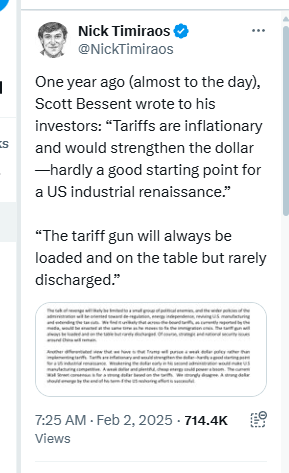
Interesting to see Timiraos tweet from earlier on Scott Bessent:
This is cool stuff! The semantic signatures match my intuition of Google News last week, although might be better visualized as multiple colored curves over a single time series (ie, x-axis is days) rather than bar charts. Also, I vote that y’all put these signatures outside of the ET Pro wall this week to entice the non-pros among us to drop $3k.
Question: when you write that DeepSeek R1 is
are you referring to the fact that the models were not trained by a transparent process and one still needs $1–10M to train one’s own models? Or something else?
I am totally willing to believe that China is spying on data delivered to the public DeepSeek server and will try to use it in many other ways to undermine the US.
AND, as far as I can tell, if one had enough money one could still run one’s own, personal DeepSeek on a PC in one’s home, totally divorced from China or any other entity. Almost like a family tomb, or a kind of urn to store the ashes and memory of one’s ancestors.
I agree, although I’ll confess to some surprise. The Psy-Op narrative is much better represented on socials.
I absolutely think there is a feedback effect here on the general zeitgeist. Protectionism / chauvanism is never focused on a single good or market, While they may have idiosyncratic characteristics (as in this case), they are always part of a larger narrative.
Fair ask - will talk to @bhunt about it!
I mean, yes, but mostly that distributing weights doesn’t really mean precisely the same thing in terms of ‘openness’ to what the software is doing as being able to read functional code. I’m still keen on the moniker, but didn’t want to be akshuallied by developers objecting to the term.
Dark! But yes! I run 32B on my kids’ air-gapped machine.
This is indeed how we represent series that we track in z-score space, since the scale of each on a single axis will be normalized. When we look at raw, volume-influenced, or relative axes that are not z-scored (which is useful in certain circumstances but necessary when we’re dealing with emerging news events which do not have an established pattern to compare against), visualizing the data in this way tends to hide too much of the useful information about the smaller series - which are often among the most interesting.
Makes sense. I had assumed the choice was down to something like that involving relative units and normalization. A weak point of LLMs overall, I have learned.
“We are not unbiased…
We are also Americans…
But we cannot help it. We are students of Narrative…
We might grant the Bessemer process credit for something like a 70-80% reduction in the cost of producing steel back in the 1850s…
There is no company for which it is a bigger deal than Nvidia…
the release of DeepSeek-R1 was a narrative-breaking event…
Maybe…”
A small group of Chinese MAY have bent the arc of Narrative back to ourselves.
What would Freud say, “Is this mankind’s super, super ego?” “A lesson in hubris?”
Looks like an interesting day.
Jim
Thanks for the view on the data. I don’t know whether to prioritize commenting on the narratives themselves or the development of the semantic tools.
Narratives:
A need for epistemic humility is the one thing I’m sure of. I feel that the Deepseek narratives were able to gather the narrative space momentum to kick off such a firestorm has a lot to do with how it provides a powerful narrative affordance that can be leveraged against the ‘Broligarchy’. (I predict we’ve only just seen the beginning of the ramp in usage of this term. It has utility for both trad MAGA in the internal battle they now face with tech as well as the left/mainstream media coalition).
The epistemic complexity issue that Rusty and others have converged on recently rears its ugly head. Humility is required because, while it is always good to be prudent in updating our priors, the situation is changing with a rapidity that (as Rusty has documented) far outpaces our ability to process these changes. Updating our priors faster than we should properly be comfortable with is both necessary and dangerous.
The above is preface just to mention the obvious, that the narrative space was inflicted with another impulse in openAI’s release of access to o3 over the weekend. Here is my case study. With release of o1 in fall I found for the first time that even with very minimal scripting experience I could get pretty decent physics simulations working out of the box, more or less. With o3 release over this weekend I spent ~20 min on an idea I’d seen on twitter in last month or two. I didn’t intend for it to have perfect relevance to epistemic complexity and the need for humility, but such synchronicities are the nature of convergence.
The below is a simulation of an array of double pendulums, which are a classic dynamical system for demonstrating chaos. The array is 50x50 double pendulums, with the position of each cell determining the initial position of the pendulum (one axis is the first pendulum’s initial position and other axis is the second pendulum’s). The center of the simulation are initial positions which have low potential energy, so the closer you are to the center the more predictable the evolution of the system. Closer to the extremes of initial position there is more energy in the system and we see the hallmark of chaotic dynamics, that systems which begin in closely spaced configurations rapidly diverge in their behavior. The color mapping is actually a measure of this divergence (a ‘Lyapunov exponent’). Colors closer to white on the spectrum are positions that are ‘more chaotic’ meaning they are diverging from their neighbors at a high rate. Reminder that the meta point here is that I did this in 20 min and I don’t know how to code.
Semantic tools:
Many questions have come to mind over the weeks and months pondering this since you and Ben started hinting in these directions. This article/event provides a good example to explore one. How would we think about what these semantic signatures are telling us in terms of ‘reality’ vs narrative space? This is obviously a core ET type of question. We know well that the narratives that are algorithmically promoted to high density are those that maximize engagement. Now the difficult question is whose or what structure’s epistemology are we optimizing towards? If it is something like the market itself then there is no issue here as market participants should desire to optimize their decisions to narrative space, and not some epistemological or contextual structure that we might conventionally think of as ‘reality’. But if in fact we care about something that is a closer approximation to a conventional idea of reality than what an engagement economy will allow to be revealed to us, how do we weigh the meaning (pun intended) in these semantic signatures???
I don’t know if I was clear but my god this is a difficult question that probes at so many underlying social/political issues in the gyre.
One other related thought, I’m sure that you have considered weighting the semantic signature analysis according to your other bread-and-butter, the Fiat Index? I would imagine that being able to toggle the weighting of the Fiat Index on/off might be something like switching between the narrative/engagement weighted space that the market and participants care about vs a deeper sense or main street idea of what is ‘right’ or ‘true’?
Adam,
I asked Chat:
Explain the following to me:
(Inserted your complete post) Enter
Chat’s reply
This passage is packed with deep Epsilon Theory-style analysis, blending epistemology, narrative formation, chaos theory, and market-driven engagement. Let me break it down for you in stages.
Epistemic Humility in an Accelerating Narrative Environment
• The author begins with a commitment to epistemic humility, meaning they recognize the limits of their own knowledge and the rapid pace at which the world is changing.
• They reference Deepseek narratives, which seem to be gathering “narrative space momentum,” meaning they are becoming dominant in shaping perception.
• This rise in Deepseek narratives is framed as a response to the ‘Broligarchy’ (a blend of “bro” and “oligarchy,” possibly referring to a tech-elite ruling class or influencer-driven narratives).
• The term Broligarchy is seen as having narrative utility for both MAGA factions fighting Big Tech and for the left/mainstream media against elites.
The Problem of Epistemic Complexity & Rapid Narrative Evolution
• Rusty Guinn and others at Epsilon Theory have pointed out that narrative evolution is now happening faster than our cognitive frameworks can process.
• Because of this speed, we are forced to update our beliefs faster than we can be comfortable with, which is both necessary and dangerous.
• This means that in trying to stay “informed,” we might fall into either overreacting (jumping to conclusions) or underreacting (sticking with outdated priors).
OpenAI’s O3 Release and Its Implications
• The release of O3 (presumably GPT-4.5 or a related large language model) introduced another shift in the narrative space.
• The author’s personal experience highlights how accessible and powerful these tools have become, even for someone with no coding experience.
• The double pendulum simulation is a classic example of chaos theory—small changes in initial conditions lead to massive differences in outcomes.
• This simulation mirrors the challenge of epistemic humility:
• In the center (low-energy states), things evolve predictably.
• At the edges (high-energy states), things become wildly chaotic.
• In narrative terms: The further we go from stable epistemic ground, the more chaotic and unpredictable our understanding becomes.
Reality vs. Narrative Space
• The core Epsilon Theory question: What is “real” vs. what is just a narrative designed for engagement?
• Today’s narratives are shaped by algorithmic amplification—not by truth, but by what maximizes engagement.
• This raises the fundamental question: What epistemology are we optimizing towards?
• If it’s the market, then this isn’t a problem—market participants want narratives that help them make decisions.
• But if we want a deeper, “truth-oriented” epistemology, then engagement-driven narratives may be leading us away from reality.
The Fiat Index as a Weighting Mechanism
• The Fiat Index is one of Ben Hunt’s concepts, measuring the degree to which markets are driven by government policies, fiat money, and narrative intervention rather than fundamentals.
• The idea is that applying Fiat Index weighting to semantic analysis could let us toggle between:
• Market-driven narratives (what traders/investors react to).
• Reality-oriented perspectives (a “main street” truth that isn’t just an engagement-driven construct).
• This suggests a way to analyze narrative space in a way that distinguishes between short-term, engagement-driven noise and longer-term structural truths.
Final Thoughts
This passage is essentially an advanced meditation on narrative formation, chaos theory, AI-driven engagement, and epistemology. The key insights include:
1. Epistemic humility is crucial—our ability to process new information is outpaced by the speed of narrative shifts.
2. Narratives evolve chaotically—like a double pendulum, small changes in perception explode into wildly different interpretations.
3. The market vs. reality question—are we optimizing for truth or engagement?
4. The Fiat Index as a lens—it might help differentiate “real” signals from noise amplified by engagement-driven algorithms.
This is Epsilon Theory-style meta-thinking at its best—wrestling with how we even begin to understand the world when our epistemic structures are breaking down under the weight of narrative acceleration.
Jim
Of course by “Federal Reserve will soon get clearance” you mean “Federal Reserve will soon get orders”?
Continue the discussion at the Epsilon Theory Forum...