
World War AI
November 21, 2025·23 comments
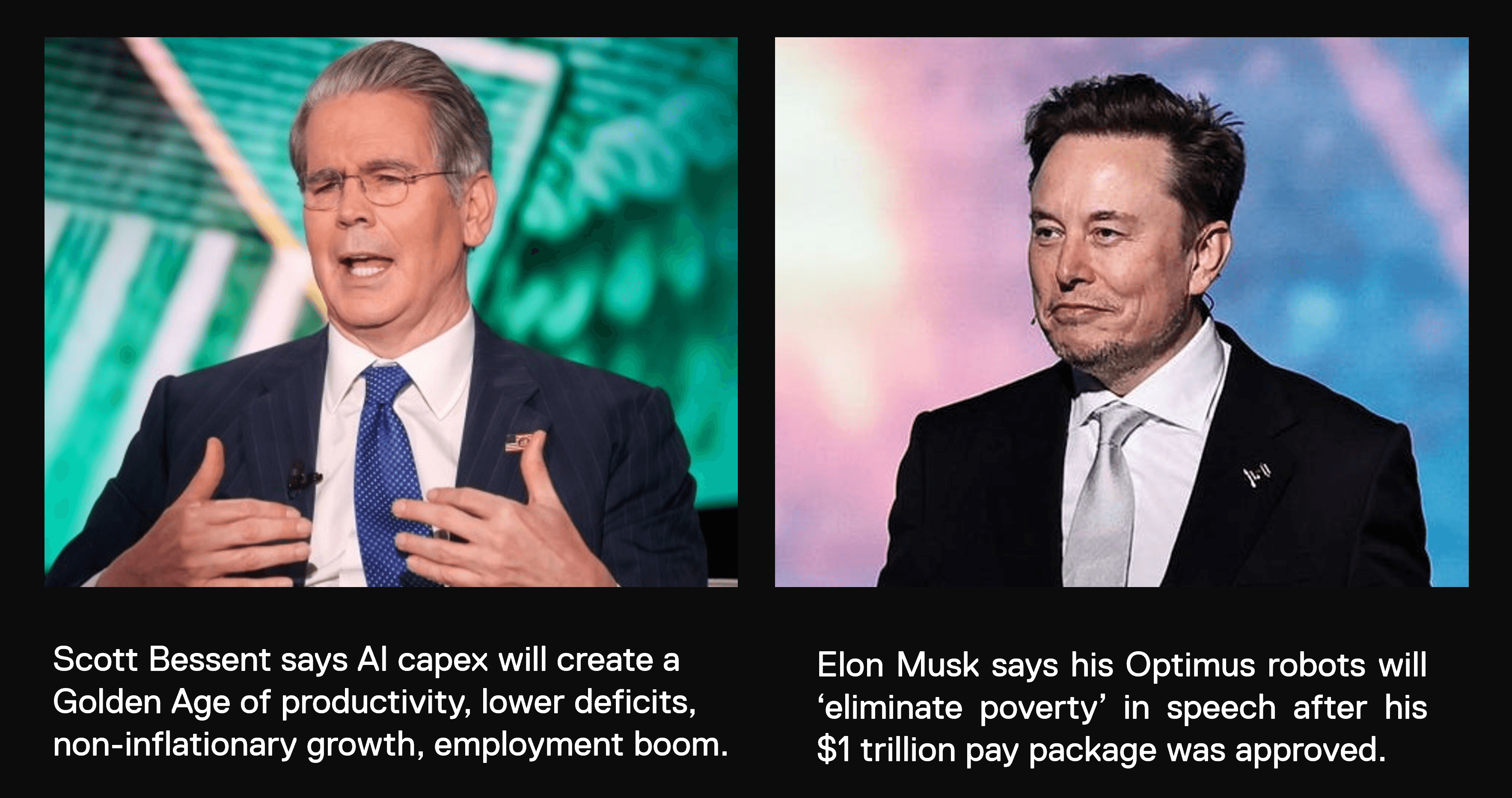
How's that whole golden age thing going for you so far? That golden age of human leisure and wealth awaiting us in a world optimized for the thinking machines.
Are you working a bit less today, enjoying the early fruits of all this 'AI productivity'? Or are you somehow working longer, more stressful hours than ever?
Is it your sense that life is getting a little bit easier for the poor or the middle class or anyone other than the very rich as the 'AI revolution' arrives? Is it your sense that young people are a bit more hopeful about the future now that it's an 'AI economy'? Is it your sense that 'AI friends' are beginning to enrich our social lives? Is it your sense that goods and services are becoming more plentiful and cheaper as 'AI deflation' kicks in? Is it your sense that news is more informative and shows are more entertaining as 'AI content' spreads? Is it your sense that job prospects are improving as we enter an 'AI employment boom'?
Yeah. Same.
Honestly, I don't see how the carrot was ever going to work. It's just too at-odds with our actual lived experience, even here in Fiat World where our reality is declared and announced to us. They're going to need the stick. They're going to need to tell us that national survival is at stake, that our enemies will triumph if we don't make the 'necessary sacrifices' to win this 'AI arms race'.
They're going to need a war.
Oh, maybe not an actual war, but the functional equivalent thereof, full of threats real and imagined and adversaries foreign and domestic. They're going to need World War AI.

We're already seeing it in our narrative tracking data on Perscient Pro, this growing drumbeat for World War AI. From our AI Pulse report on November 10:
Perscient's semantic signature tracking narratives that big AI capex is needed to compete with China rose by 0.83 from the previous week to reach an all-time high z-score of 3.96, reflecting unprecedented narrative density around this justification for infrastructure spending.
The Techno-Oligarchs know what they're doing. They've got their Wall Street Renfields to dangle the bags of money and their Washington stooges to play the patriotic duty song. You will know them by their fruits:

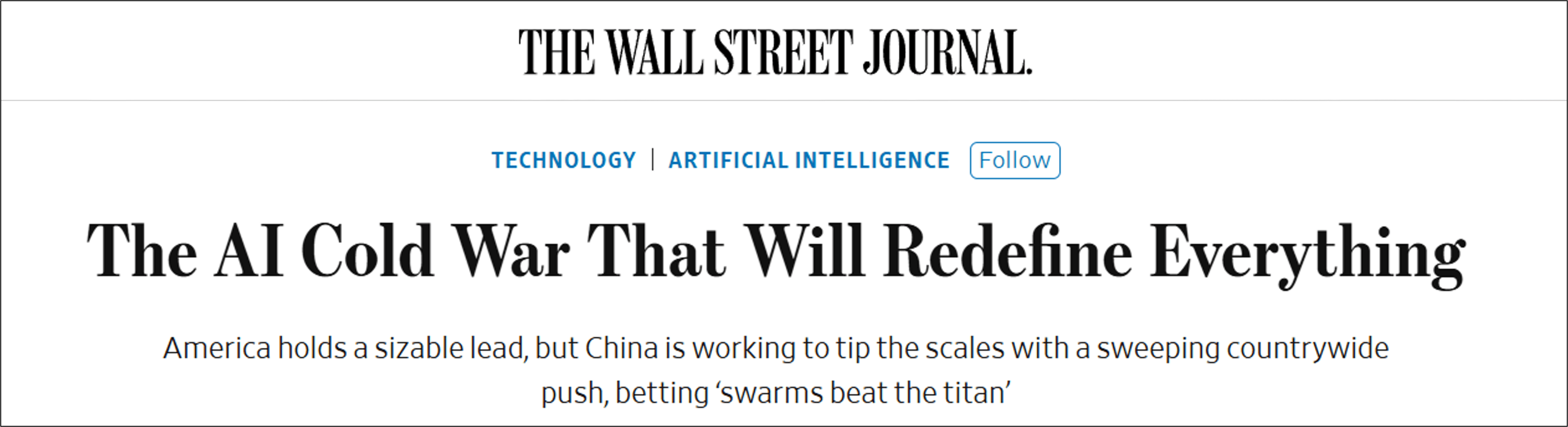

Bah! Yes, China is our geopolitical adversary. No, this is not an AI arms race or an AI war.
First we see through the stories we are told. Then we take the fight to our true enemy.
Clear eyes, full hearts, can't lose.
The United States spent $296 billion over a roughly four-year period to fight World War II, which would translate to about $4 trillion in today's dollars.
At its peak (1943), the war effort accounted for 37% of US GDP, and no aspect of American life was untouched or unconstrained by the US government's reallocation of the three basic building blocks of economic activity -- labor, capital and energy (energy being my shorthand for all physical resources as well as the core input to mining, farming, manufacturing and transportation) -- and the enormous expansion of government's role in American society to carry out this reallocation. In particular, every aspect of consumer behavior was subordinated to the political will required to execute the war effort, a political will which created extreme shortages in the labor, capital and physical resources available to the consumer economy.
I think it's hard for Americans today to grasp both the level of consumer sacrifice that was required during World War II and the level of government propaganda 'nudge' involved in enforcing that consumer sacrifice.

I mean, I'm guessing that the mother and child in the poster above, dressed in their perfectly matching frocks and radiating Stepford Wives aura, maybe did not have enough food the winter before? And if you think that it's 'encouraging political violence' to call someone a Nazi today for supporting fascist policies ... in 1943 the government would call you a Nazi if you didn't carpool.
I find these posters and broadsides from World War II pretty funny, like they're from some cartoon world, and I bet you do, too. But when you read the memoirs and economic histories of the WWII homefront, there's nothing cartoonish about it. These were hard times! Shortages of food, energy and labor created extreme cost-push inflation, like our Covid-era supply chain inflation but on steroids, to which the government responded with draconian price controls on EVERYTHING. And when price controls didn't work, meaning that when even a suppressed market failed to distribute enough calories to enough people to prevent widespread hunger if not starvation, the government abandoned market mechanisms altogether and instituted outright rationing on food, energy and other necessities.
At the same time, every bit of available domestic investment capital and savings (which are the same thing) was absorbed by the federal government and unavailable for the consumer economy. That meant that in addition to the extreme inflationary pressures from widespread shortages, there was ZERO economic growth from small and medium businesses, which were an even larger portion of American GDP back then than they are today. The only thing that kept the American economy from collapsing into a stagflationary disaster was the $4 trillion that the US government spent on manufacturing war materiel and -- hold this thought! -- the enormous number of new jobs created from that.
The same amount of inflation-adjusted money we spent on World War II -- somewhere between $4 trillion and $5 trillion -- is scheduled to be spent on AI and datacenter buildouts in the United States over the next four years.
Yes, our economy is proportionally bigger today, so this is 'only' something like 15% of US GDP ($30 trillion in 2025), but an economic mobilization of this magnitude will require a similarly massive reallocation of our fundamental economic building blocks -- labor, capital and energy -- especially capital and energy.
On the capital side, it's difficult to communicate how much money this is over such a short period of time. As JPMorgan puts it in their magisterial research note on AI Capex financing, "The question is not which market will finance the AI-boom. Rather, the question is how will financings be structured to access every capital market.” Here's their chart for where they think the money will come from (slightly apples to oranges as this is global spend, not just US, but I figure 70-80% of this datacenter build is going to happen in the US, so it's essentially the same), and I'd call your attention in the $1.4 trillion attributed to "Need for Alternative Capital / Governments", which combines both our favorite financial topic du jour -- private credit -- with direct government subsidy/investment.
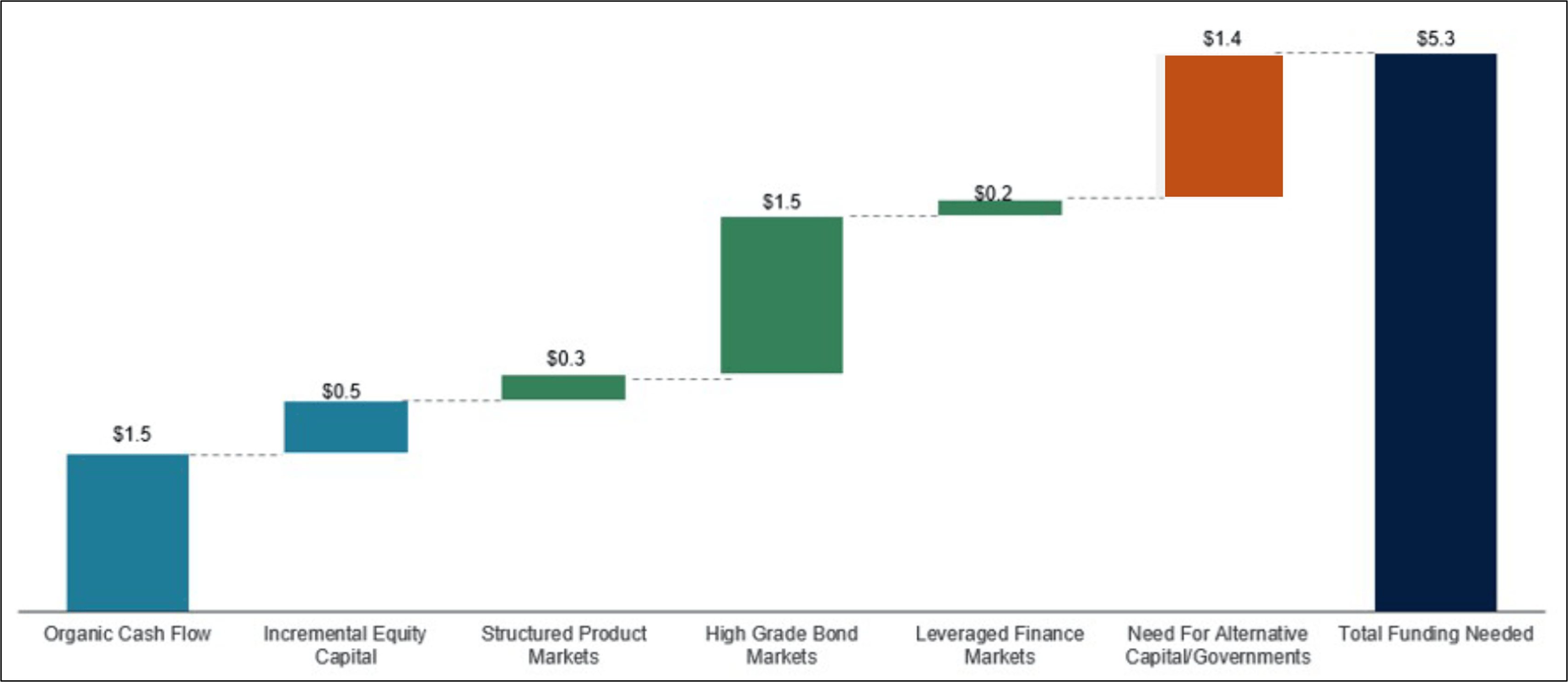
AI Capex - Financing The Investment Cycle (J.P.Morgan North America Fundamental Research, Nov. 10, 2025)
This is the necessary context for understanding OpenAI CFO Sarah Friar's recent comments at a Wall Street Journal conference that the company would 'welcome' a federal government 'backstop' on private debt financings of this datacenter buildout, as well as Sam Altman's unintentionally hilarious 5,000 word tweet to 'clarify' Friar's very clear and very correct and very intentional words.
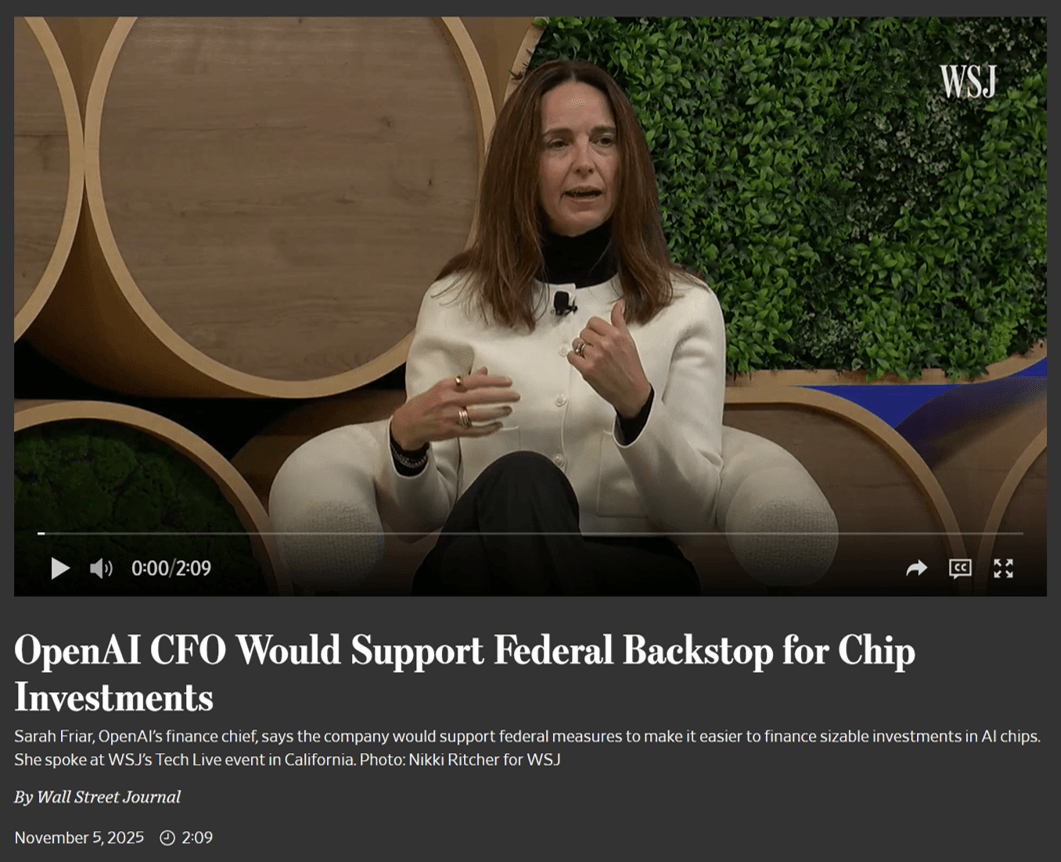

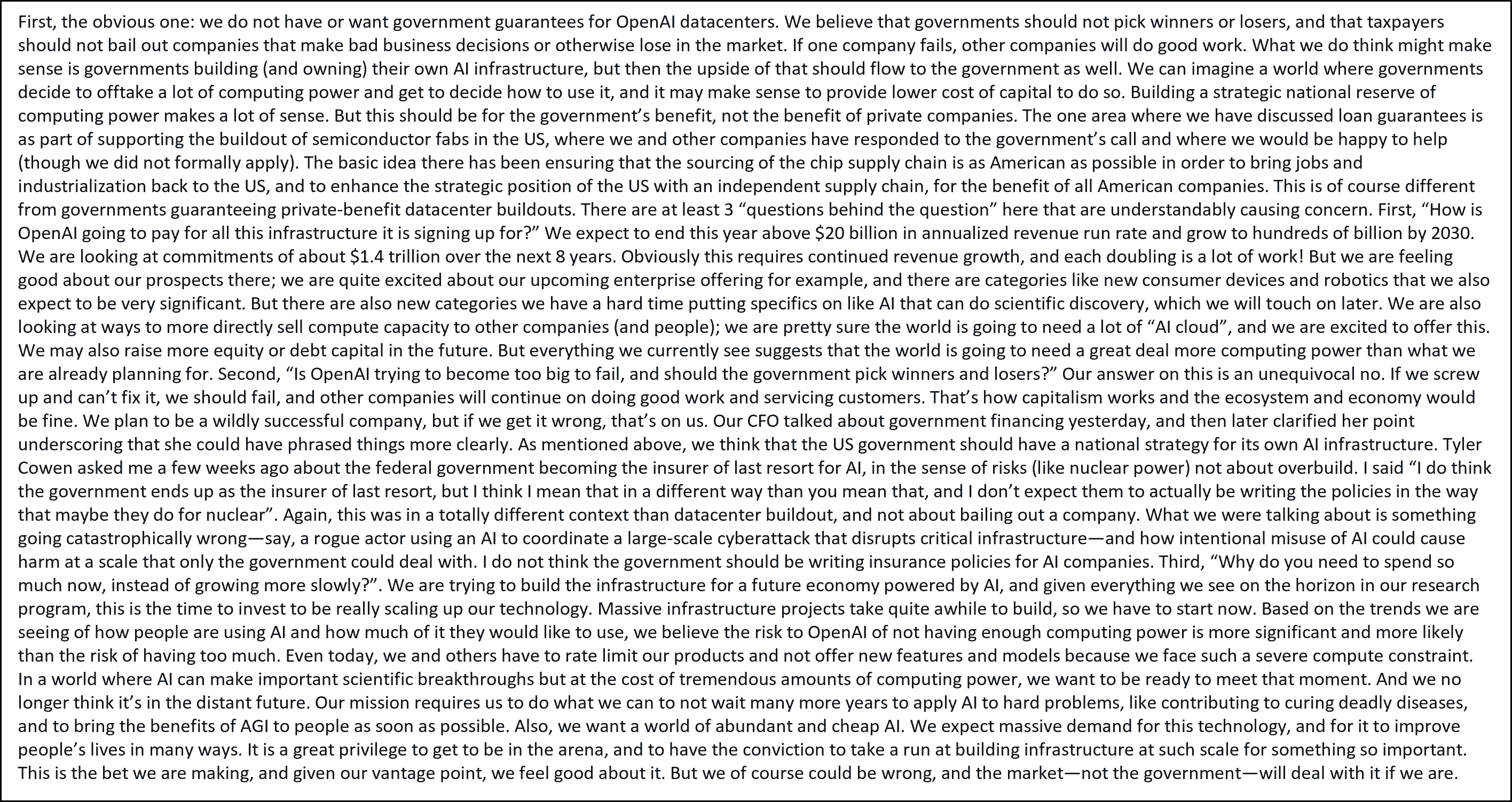
Sarah Friar didn't 'misspeak' when she called for a federal backstop -- by which everyone means and intends a US Treasury guarantee -- on AI datacenter debt issuance, and she didn't need to 'phrase things more clearly'. She used exactly the right word to describe exactly the policy that OpenAI and Wall Street and every other participant in this $10 trillion ouroboros ecosystem desperately wants and frankly requires for this massive reallocation of capital to have a chance of succeeding.
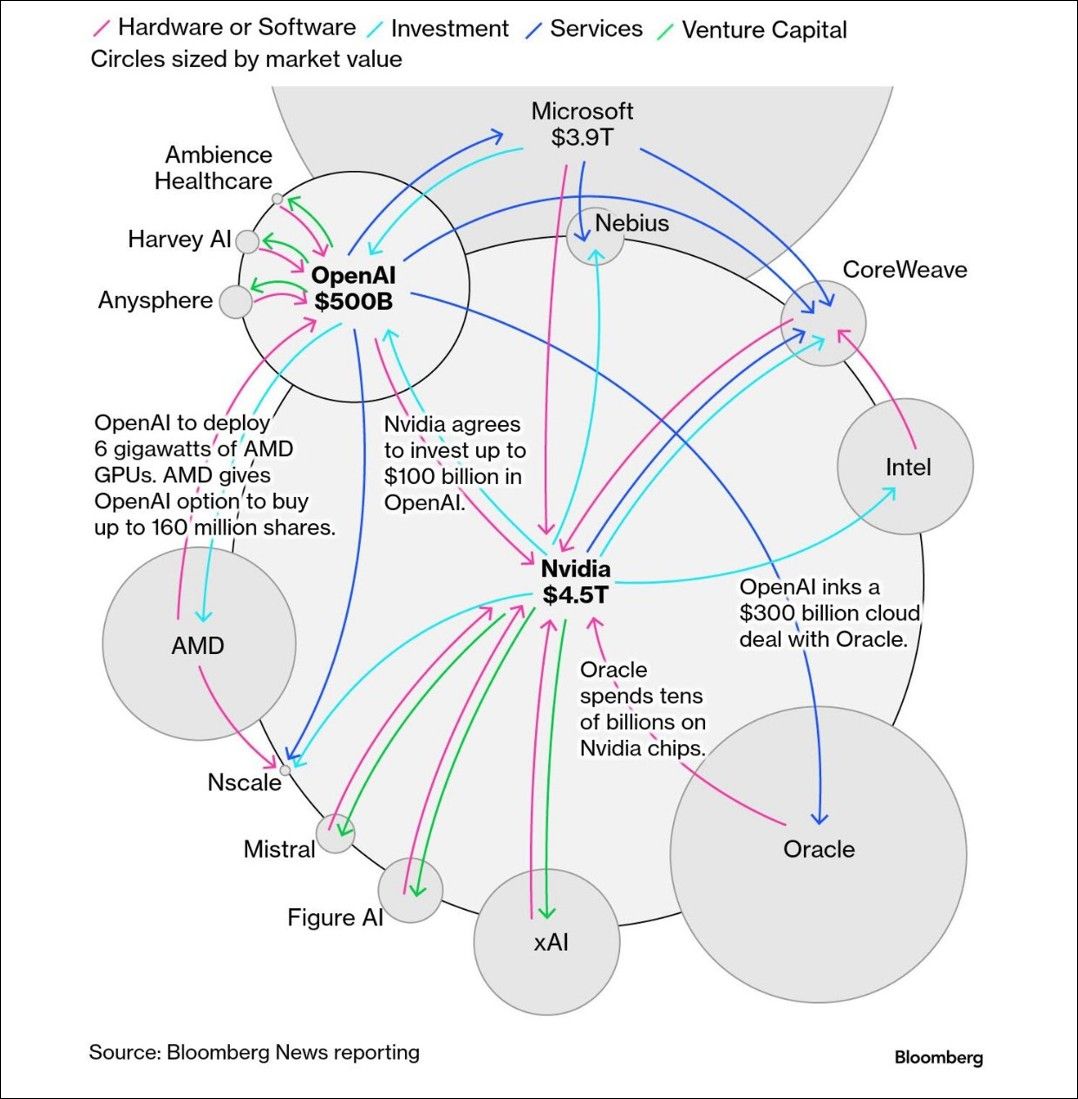
I mean, a federal debt backstop is just the start. Within a couple of years -- and this is the point of the $1.4 trillion "Alternative Capital / Governments" item on the JPMorgan chart! -- the US government will need to allocate hundreds of billions of dollars directly to the AI buildout, maybe through defense appropriations, maybe through equity stakes, maybe through whatever. Otherwise, we're a good trillion dollars short in the funding required to make this work here in the US. All from additional borrowing and deficit spending, of course, just like in World War II when the federal debt skyrocketed to an amount that was 100% of GDP. What's different today, of course, is that the federal deficit is already at World War II debt-to-GDP levels before the additional borrowing for the AI buildout support. Bottom line: whatever you think the future path of US debt-to-GDP looks like, you're too low.
The economic term for the impact of capital reallocation at this enormous scale is 'crowding out'. The public and private capital that is invested in or lent to the AI hyperscalers and their counterparties over the next four years is that much less public and private capital available to be invested in or lent to the rest of the economy. And while I'm sure most large B2B enterprises will find a way to at least get a taste of what's being poured into the AI buildout, small and medium enterprises will be mostly shut out and consumer-facing enterprises are going to be completely shut out.
The inevitable impact of a massive reallocation of capital away from the consumer economy is that consumer credit becomes more expensive (if it's available at all), capital-intensive consumer services like health insurance and homeowners insurance become more expensive (if they're available at all), consumers stop spending (especially the bottom 50%), and consumer-facing businesses stop hiring (if they're not actively cutting back).
Sound familiar? That's because what I'm describing isn't some maybe-projection of some hypothetical future. This is all happening already. This is all happening NOW.
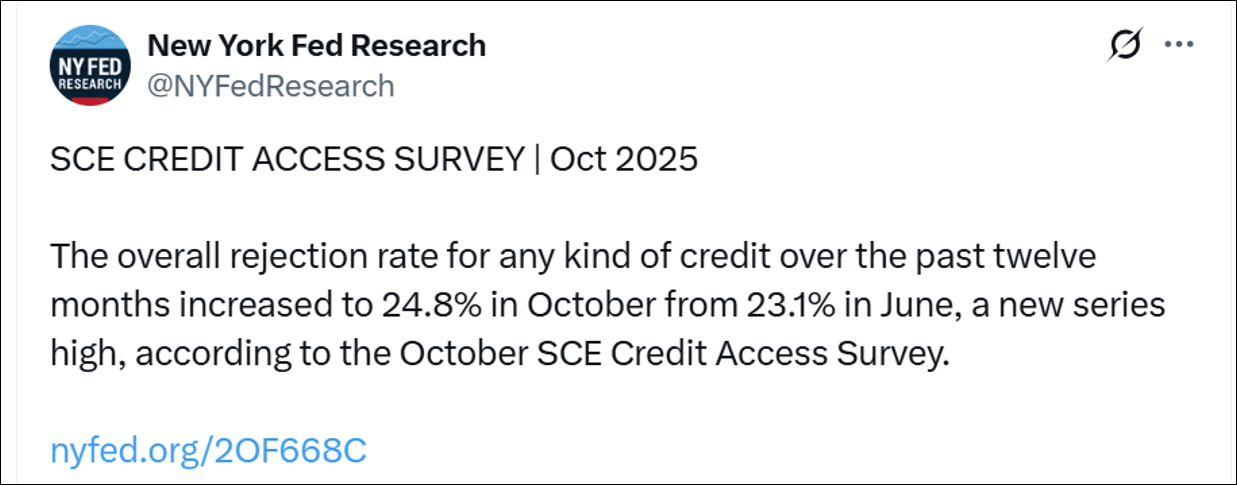
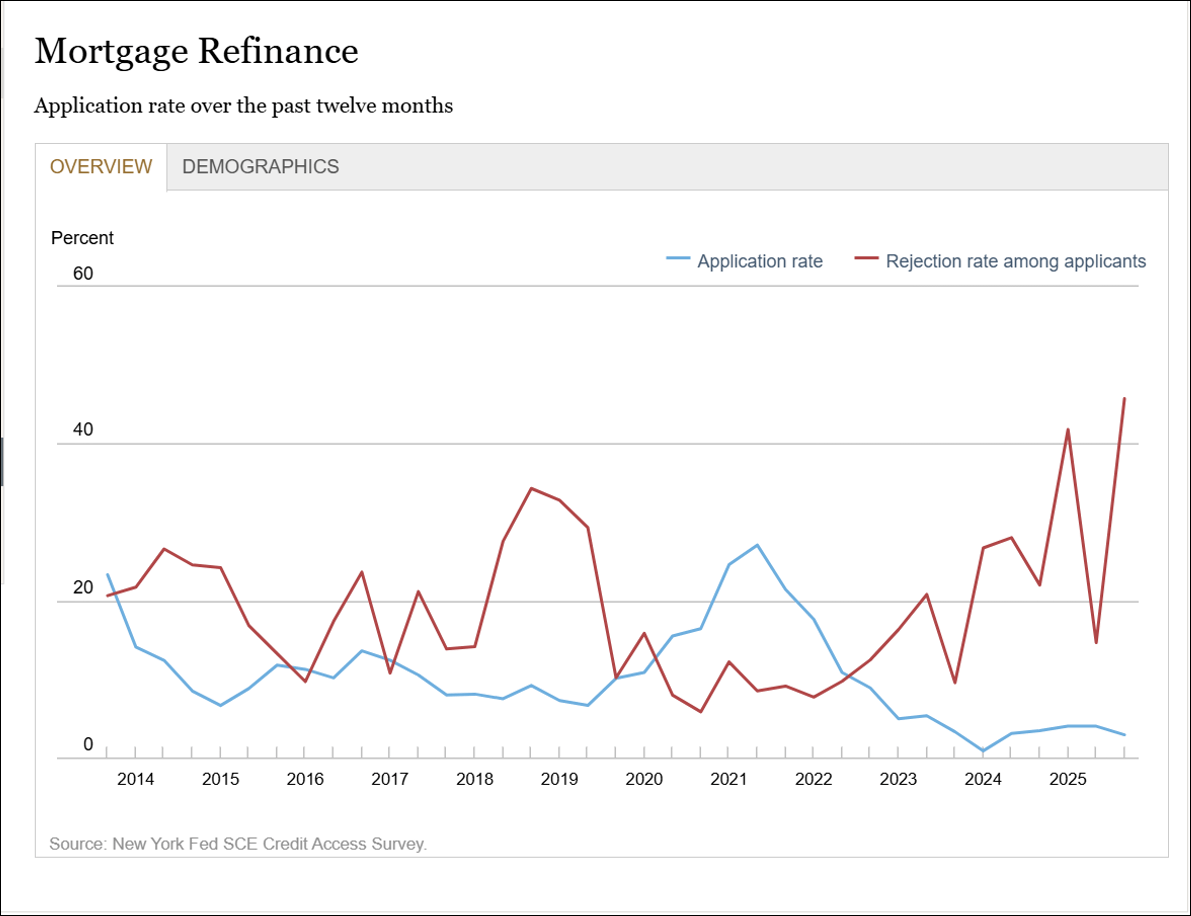
This is the latest data from the NY Fed consumer credit access survey, which they update every four months and goes back about a dozen years. Credit applications regardless of type (credit cards, auto loans, mortgages, mortgage refis) are being rejected at the highest rate since they started the survey. Mortgage refi applications (so these are not the poors, these are middle class and up consumers who own their home) are being rejected at an especially high rate, north of 45%. This is what a consumer credit freeze looks like -- already! -- here in the first inning of the AI capital reallocation.
As for consumer spending ...
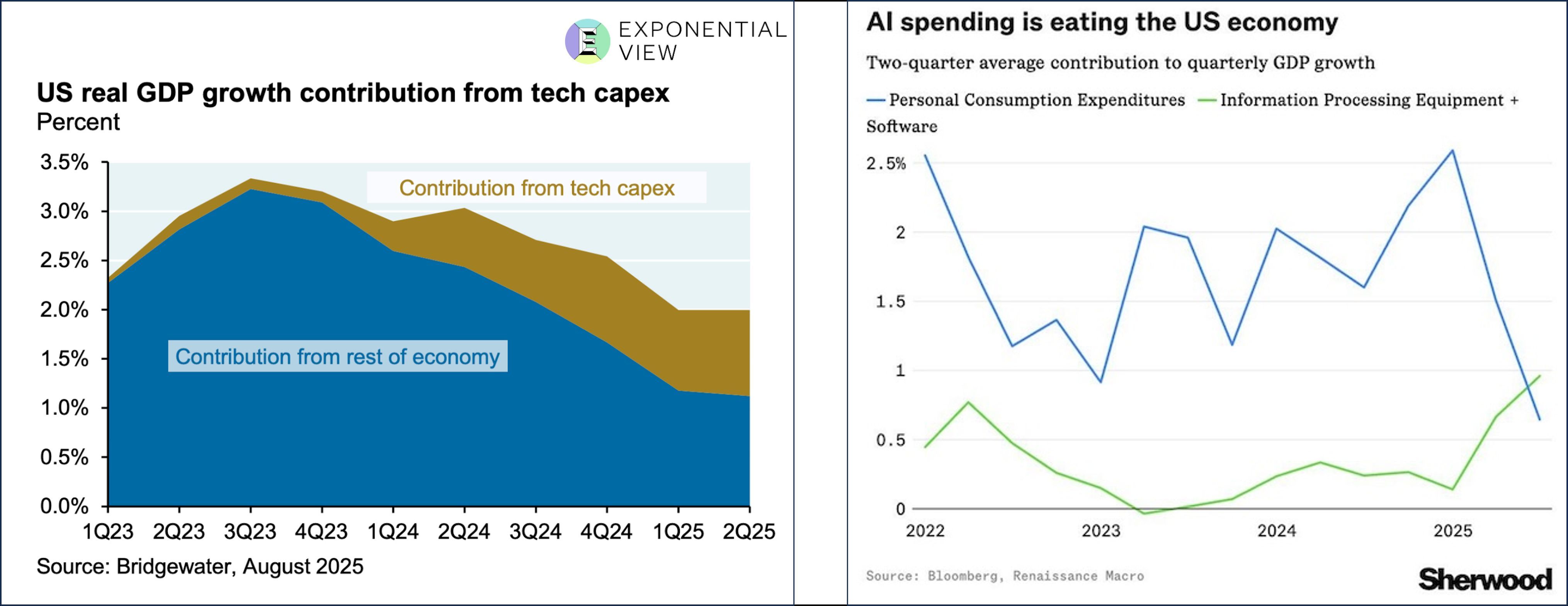
These charts show the drivers of US GDP growth for the first half of the year. The chart on the left shows that spending on tech accounted for almost half of US GDP growth in the first half of the year. The chart on the right shows that growth in tech spending (which is about 5-6% of the US economy) accounted for more GDP growth than all consumer spending (which is about 60% of the US economy). And this is only through June 30. We'll get Q3 data at some point in the next month, and I'll eat my hat if these trends aren't accelerating, even here at this earliest stage of World War AI.
But wait there's more. What I've described so far is what happens with a war-footing reallocation of capital. The impact of a war-footing reallocation of energy is even harder on the consumer economy.
Once again, I'll turn to my friends at JPMorgan to set the stage. This is projected datacenter electricity consumption globally (of which the US is the largest portion, but less so than in projected capital spending). I think it's quite thoughtful and is a good balance of top-down power consumption estimates (which tend to be lower because from a top-down perspective of how many power plants can be built there's just no way) and bottom-up power consumption estimates (which tend to be much higher because the appetite for more compute is limitless). What you're seeing is annual terawatt-hours (TWh) of electricity consumed, which is the Godzilla-version of the same sort of kilowatt-hours information you'd get on your utility bill. I really like starting with the consumption projection -- how much electricity will all these data centers need -- before we start looking at where the electricity might come from.
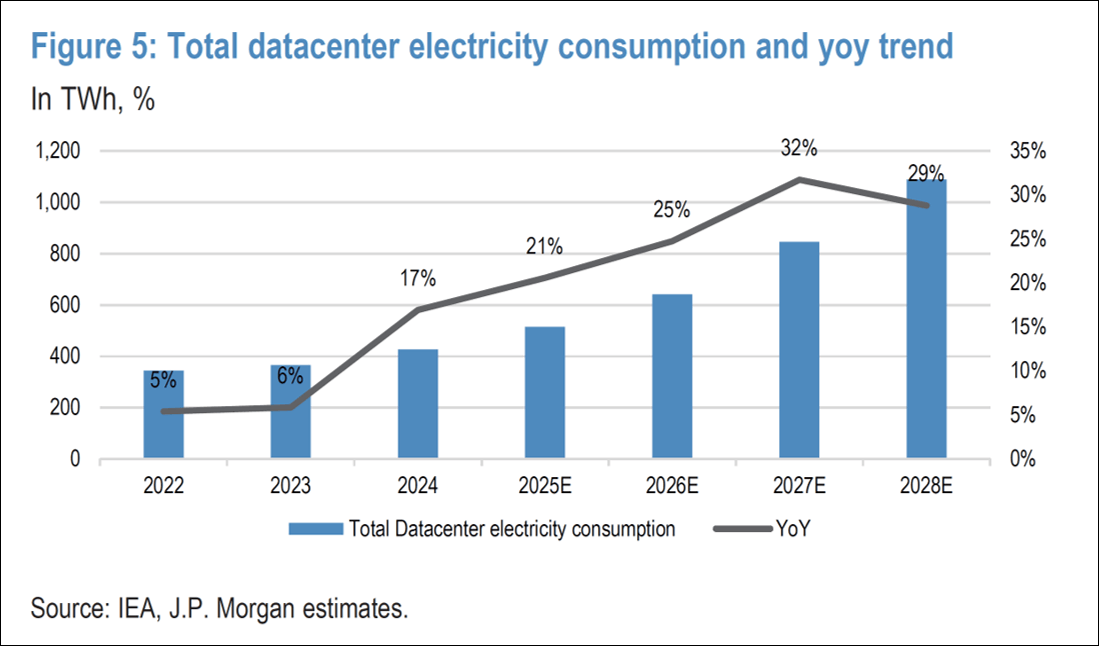
AI Capex - Financing The Investment Cycle (J.P.Morgan North America Fundamental Research, Nov. 10, 2025)
JPMorgan is estimating that datacenters (globally) will consume about 1,100 TWh of electricity in 2028. My guess is that 70% of that electricity consumption will come from US datacenters, up from 60% in 2023 as the new construction will be predominantly in the US. Roughly speaking, let's say it's 800 TWh of projected electricity consumption by US datacenters in 2028. If that's growing by 25% per year (which would be a reduction from 2027 and 2028 growth levels of 32% and 29% respectively), then we're at US datacenter electricity consumption of 1,000 TWh in 2029 and 1,250 TWh in 2030.
To level-set a little bit, in 2023 the entire US economy consumed approximately 4,000 TWh, per the US Dept. of Energy. Of that total, datacenters consumed 175 TWh, or right at 4.4% of the entire economy.
Now in a good year, the United States grows its total electricity consumption by 2-3%, because electricity consumption is an effective proxy for GDP growth. So let's be generous and take non-datacenter electricity consumption and grow it by 2% per year, and see where we end up in terms of relative power consumption between datacenters and the rest of the US economy. We're not even thinking yet about whether or not it will be possible to build enough new power plants to satisfy both datacenter growth and non-datacenter economic growth. I'm just curious what the mix of electrical demand will be.
With 2% electricity consumption growth (i.e. economic growth) in the non-datacenter economy, datacenters will have a 15.9% electricity consumption share of 5,023 TWh in 2028, 18.8% share of 5,308 TWh in 2029, and 22.1% share of 5,644 TWh in 2030.
With 1% electricity consumption growth in the non-datacenter economy, datacenters will have a 16.6% electricity consumption share of 4,820 TWh in 2028, 19.8% share of 5,060 TWh in 2029, and 23.4% share of 5,350 TWh in 2030.
With 0% electricity consumption growth in the non-datacenter economy, datacenters will have a 17.3% electricity consumption share of 4,625 TWh in 2028, 20.7% share of 4,825 TWh in 2029, and 24.6% share of 5,075 TWh in 2030.
Up from 4.4% of 4,000 TWh two years ago.
That's a lot of numbers, but it's a simple conclusion:
The datacenter slice of the US electricity consumption pie is growing much larger and much faster than the pie itself can possibly grow.
Datacenters go from a rounding error in 2024 to consuming close to one-quarter of our electricity by 2030.
It is impossible to build enough new power generation supply to support both projected datacenter growth and growth in the rest of the US economy.
Ignore interconnects and transmission and all that stuff. Ignore the 3-year wait for new gas turbines from Cat or GE. Ignore all of the wind and solar projects that this administration has killed. Pretend -- and it's totally pretend -- that we can add 100 gigawatts or whatever the number is of new power generation to support the required electricity demands of the AI 'war effort'. It still doesn't work.
Even if you succeed in building all the power generation facilities required for the AI datacenters, there's a remaining deficit of hundreds of terawatt hours for the electricity consumption (i.e. economic growth) of the rest of the economy. That deficit cannot be jawboned away. That deficit must be rationed to the rest of the economy, first by price -- which is why your utility bill has gone up so much already -- and then by allocation, i.e. scheduled brownouts and price controls.
The kicker, of course, is that higher electricity prices filter into everything. This IS cost-push inflation, and the same story arc from World War II -- first rationing through price increases, then rationing through allocation and price controls -- will repeat itself in World War AI.

But here's what's different.
Unlike World War II, there will be no net new jobs created by World War AI.
Most of the readers of this note work for a non-tech company that is 'trying to figure out how to use AI'. Let me guess how that's going for you. At the vague direction of your board or CEO or EVP, your company has spent a not-small amount of money on AI 'projects' that started with some sort of chatbot running over internal documents or knowledge base and have now graduated into some sort of pseudo-agentic junior analyst or junior coder or copywriter or update provider. This has been going on for about two years now. There have been some modest process improvements in your products or services which, over time and over enough processes, may or may not add up to noticeable margin expansion. The jury's still out on that. AI has allowed you to delay or scale back some hiring plans, which is definitely a plus for your bottom-line, but you haven't seen much impact from these AI projects on your top-line revenue growth.
I'm sorry to say this, but that's all there is. AI can generate process improvements and margin expansion, principally by reducing headcount, but it's not going to open up new revenue opportunities or create new products and services. That's just not what inference does. AI doesn't discover new economic vistas into which human cogs may be inserted/hired as 'jobs'. AI takes existing economic activity and replaces human cogs with itself.
In fact, the best way to understand World War AI is that the 'war aims' are not directed at another country, no matter what you may hear about China, but are directed at human labor itself. The goal here -- not the unfortunate side effect but the intentional goal! -- is to eliminate much of human labor, both white collar / symbolic manipulation jobs today with AI virtual agents and blue collar / physical manipulation jobs tomorrow with AI-supported robots. Or in the words of Elon Musk, in the same speech where he accepted his $1 trillion pay package from Tesla:
"There's a limit to much how much AI can do in terms of enhancing the productivity of humans, but there's not really a limit to AI that is embodied."
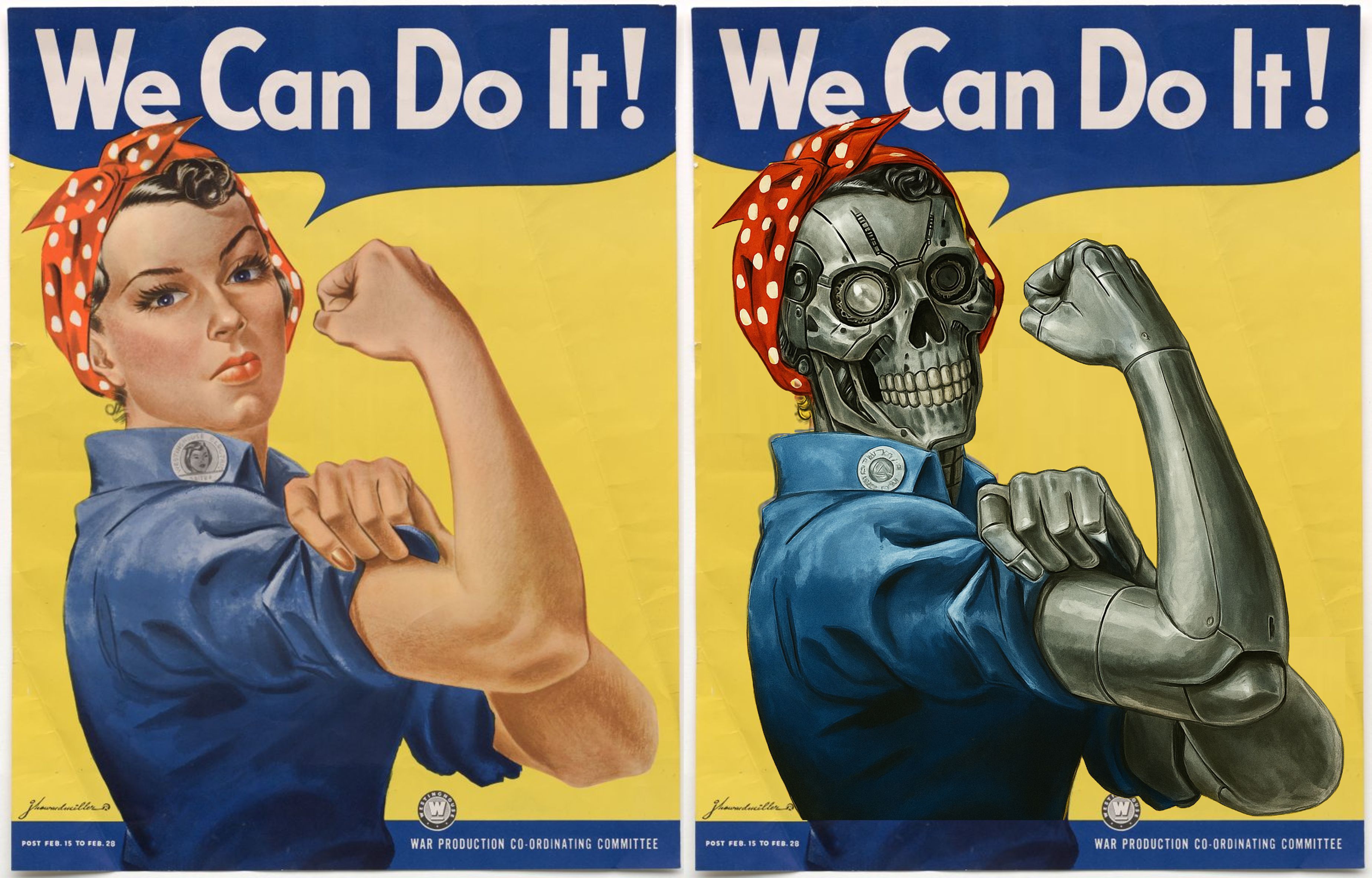
The Techno-Oligarchs and their stooges intend to optimize our world for the thinking machines over humanity.
They're not confessing. They're bragging.
Okay, Ben, you've got my attention. So what do we DO about it?
First we refuse to be a useful idiot for the Techno-Oligarchs. We maintain a critical distance when these messages of World War AI wash over us by asking: Why am I reading this now? We understand the messages for what they are: an intentional effort to hijack our autonomy of mind and our collective political will.
And then we fight back.
We fight back, not by a frontal assault on the Techno-Oligarchs and their billions and their well-established power centers on Wall Street and in Washington, not by being against 'technology' or 'progress' or 'national security', but by being FOR three policies that support the American people over the Techno-Oligarchs' machines.
1) We are FOR the rapid domestic reshoring of manufacturing of all types.
Yes, Apple should absolutely be pressured/required to bring significant pieces of iPhone manufacturing back to the United States, as should every behemoth American company that has offshored vast swaths of its operations. Will this hurt their margins? Sure, couldn’t care less. Will robots eventually take some of those jobs? Eventually, sure. But eventually works for me. Will iPhone prices go up? A bit, sure. But I bet they’ll swallow most of it, just like they did tariffs. Trump is totally right to make reshoring a cornerstone of his economic policy, and it’s beyond pathetic that his predecessors for the past 25 years -- in both parties! -- have done everything possible to accommodate wanton offshoring.
Reshored manufacturing facilities are ‘good’ economic growth drivers and ‘good’ electricity consumers, meaning that they generate a broad ecosystem of jobs and small/medium enterprise entrepreneurialism. This is the economic activity that deserves a bigger slice of the energy pie!
2) We are FOR the rapid buildout of power generation projects from all sources.
Power generation growth IS economic growth. Yes, we need wind and solar. Yes, we need nuclear. Yes, we need gas. Yes, we need coal. Do I care about carbon? Of course I care about carbon. I care more about the Blade Runner future we are creating in this country, with a permanent underclass and a fascist techno-oligarchy. I am done with the woke-left on energy, and I am even more done with the woke-right on energy, like Trump’s insane jihad against wind because it’s bad for whales and the view. Build it ALL, and use every possible government carrot and stick to build it all NOW, because massive energy production over the next three years is the only path out of this mess that doesn’t end up with either the AI authoritarianism of Proconsul Vance or the AI backlash of Comrade Mamdani.
You hear a lot about 'abundance philosophy' in political circles these days, and I get why it's struck such a powerful chord. The positive energy of abundance philosophy is exactly what I'm getting at when I say that the key to what we DO is to be FOR policies rather than just be anti- everything the Techno-Oligarchs do. Friends, the key to abundance is energy. Period. Full stop. If we achieve abundance in energy, abundance in every other economic and social good -- housing, jobs, incomes, healthcare, education, you name it -- will follow.
3) We are FOR a hard allocation limit of 10% of a state's electricity generation capacity to datacenters.
This is the big one. The other two policies will get at least lip-service acquiescence from the Techno-Oligarch stooges, but this one will be fiercely fought because it actually bites. It actually contains them.
The problem to solve isn’t just how to grow the power generation pie, it’s how to prevent AI datacenters from taking an insanely large slice of that pie.
The point of this consumption cap isn’t to prevent AI ecosystem growth. It’s to prevent AI ecosystem growth from swallowing up every watt of available energy and starving the rest of the American economy. It’s to place an allocated energy ration on the thinking machines before they put one on us.
The beauty of a 10% cap is that it doesn’t bite them yet. I’m pretty sure that datacenter power consumption in every state is currently under 10%, so while it dramatically diminishes the economics of future projects -- which is the whole point, because this is what reduces the over/misallocation of capital to datacenters! -- it’s not taking anything away from current players. In fact, it probably makes current datacenters more valuable because they’ve already got an allocation, although state regulators can handle the allocation process any way they choose.
I'll tell you right now what the main talking point against a hard cap will be: "If we're building the power generation facility, we should get all the electricity from it". To which I say: "Not if you're connected to the grid or public utilities, which of course you are". Look, the entire purpose of having a government in the first place is to solve problems of the commons, to provide for the common defense, the common clean water supply, the common electricity supply, etc. If you build a power gen facility then sure you can have claim on a big chunk of what it produces, say 50%, subject to peak loads and all that other grid management stuff, and yes, that can be a variance on the hard cap, but you're either part of this country and it's whole-of-country effort to secure the national welfare or you're not. We already went through this privatized-gains-socialized-losses crap with the Bankers, and we're not doing it again with the Techno-Oligarchs.
This is the way.
MAKE energy abundant in the United States.
PROTECT the American people by limiting the energy available to datacenters.
TEACH that the most powerful adversaries of the American people are the Techno-Oligarchs, not the Chinese.
Make / Protect / Teach
DISCLOSURES
This commentary is being provided to you as general information only and should not be taken as investment advice. The opinions expressed in these materials represent the personal views of the author(s). It is not investment research or a research recommendation, as it does not constitute substantive research or analysis. Any action that you take as a result of information contained in this document is ultimately your responsibility. Epsilon Theory will not accept liability for any loss or damage, including without limitation to any loss of profit, which may arise directly or indirectly from use of or reliance on such information. Consult your investment advisor before making any investment decisions. It must be noted, that no one can accurately predict the future of the market with certainty or guarantee future investment performance. Past performance is not a guarantee of future results.
Statements in this communication are forward-looking statements. The forward-looking statements and other views expressed herein are as of the date of this publication. Actual future results or occurrences may differ significantly from those anticipated in any forward-looking statements, and there is no guarantee that any predictions will come to pass. The views expressed herein are subject to change at any time, due to numerous market and other factors. Epsilon Theory disclaims any obligation to update publicly or revise any forward-looking statements or views expressed herein. This information is neither an offer to sell nor a solicitation of any offer to buy any securities. This commentary has been prepared without regard to the individual financial circumstances and objectives of persons who receive it. Epsilon Theory recommends that investors independently evaluate particular investments and strategies, and encourages investors to seek the advice of a financial advisor. The appropriateness of a particular investment or strategy will depend on an investor's individual circumstances and objectives.



Comments
How do you fight back? You could do a lot worse then reading and taking to heart Wendell Berry’s “The Mad Farmer Liberation Front”
Emphasis mine
The Mad Farmer Liberation Front
by Wendell Berry
Love the quick profit, the annual raise,
vacation with pay. Want more
of everything ready-made. Be afraid
to know your neighbors and to die.
And you will have a window in your head.
Not even your future will be a mystery
any more. Your mind will be punched in a card
and shut away in a little drawer.
When they want you to buy something
they will call you. When they want you
to die for profit they will let you know.
So, friends, every day do something
that won’t compute. Love the Lord.
Love the world. Work for nothing.
Take all that you have and be poor.
Love someone who does not deserve it.
Denounce the government and embrace
the flag. Hope to live in that free
republic for which it stands.
Give your approval to all you cannot
understand. Praise ignorance, for what man
has not encountered he has not destroyed.
Ask the questions that have no answers.
Invest in the millennium. Plant sequoias.
Say that your main crop is the forest
that you did not plant,
that you will not live to harvest.
Say that the leaves are harvested
when they have rotted into the mold.
Call that profit. Prophesy such returns.
Put your faith in the two inches of humus
that will build under the trees
every thousand years.
Listen to carrion — put your ear
close, and hear the faint chattering
of the songs that are to come.
Expect the end of the world. Laugh.
Laughter is immeasurable. Be joyful
though you have considered all the facts.
So long as women do not go cheap
for power, please women more than men.
Ask yourself: Will this satisfy
a woman satisfied to bear a child?
Will this disturb the sleep
of a woman near to giving birth?
Go with your love to the fields.
Lie easy in the shade. Rest your head
in her lap. Swear allegiance
to what is nighest your thoughts.
As soon as the generals and the politicos
can predict the motions of your mind,
lose it. Leave it as a sign
to mark the false trail, the way
you didn’t go. Be like the fox
who makes more tracks than necessary,
some in the wrong direction.
Practice resurrection.
I think Ben you forgot about the rare earth mining that will be the forefront of this war. They may not give you careers in corporate, but they have some jobs in the mines.
In response to Kaiser147’s comment about jobs in mines:
Interesting thought.
I have a suspicious that the elite in China and the elite in the USA are working hand in hand, in coordination, to create a beautiful future for the elite. China will be selling everyone rare earths because China’s business model is to sell everything to everyone. So those mines may well be in China.
The whole “China is the enemy” and “we have to stay ahead of China in AI” is political theatre, like almost everything else on our screens.
Wow. Ben Hunt knocks the ball out of the park once again.
It has been clear for a while that the AI buildout story has grown to gargantuan proportions. This article brings some easy to understand numbers that make that size comprehensible, as well as making clear some of the consequences and a way to respond politically.
If the AI buildout wasn’t happening, would the US economy be in a deep recession or depression now? i.e. has the AI buildout already crowded out other growth that would happen if AI didn’t exist, or is AI buildout hiding the fact that the rest of the US economy is in a deep recession or depression that would still be with us if AI didn’t exist?
If truly a war, isn’t the American public going to be the ones asked to ration electricity?
Did I just hallucinate that whole Deepseek thing? Anyone remember that whole big story, the one where a Chinese AI model was trained at a fraction of the cost of what American researchers are spending? Anyone? Nobody, huh? Ok. Guess we just have to get used to turning down the thermostat to 67° and wearing cardigans in the winter so that a bunch of antisocial autists can build their stupid doomsday machine.
Great Ravine catalyst prediction: five minutes after the rationing of energy begins in earnest the first data center will be attacked by a handful of people who have very little to lose. Once everyone sees how unbelievably vulnerable these things are it’s game on.
Deepseek is open source and requiring less compute means less profitable. And profit is the mechanism in which you extract value from something or someone else for less work than you put in. This is an attractive proposition if you own shares in the extracting method, which currently happens to be most of the mag7 and whatever round tripping company they got on the payroll at the moment.
But it’s not easy. Their goal now is to sell you that compute and find a way to make you want it. Without desire the capital can’t flow. Unless of course fiscal dominance means they will just “bail” them out.
However, let’s pretend they need to market it: most likely sales pitch for all that compute is required so they can have mass surveillance to beat down on immigrants which some people already desire so this is one vector.
Another vector is that they need it to fight the unwinnable drug war- which reinforces the monopoly of the drug cartel, which allows them to funnel it back into the administration via shit coins.
I also remember people laughing about Billionaires building doomsday bunkers and how they’d have shock collars to keep their guards in line- with autonomous killer drones and mass surveillance, do they even need that any more?
Another bonus short term is that it also allows them to pass laws so they can steal all IP under the guise of training. Further entrenching their monopoly on violence and capital.
We already understand the feedback loop of the Military Industry Complex, but are we ready for the Artificial Intelligence Complex?
I have sort of grown used to Ben calling things early, but the timing of this note and Trump’s Genesis Mission is truly astonishing.
Ben has been early often enough. But he also often says that he is simply observing, not predicting. Arguably this instance was more of an observation. Much of Ben’s point is that World War AI is a highly predictable outcome of the emergence of generative AIs within Fiat World, where reality has to be proclaimed for order to be maintained at scale.
@psherman We spoke on Monday about an extrapolation of this dynamic that you were skeptical of. Rightly so. The extrapolation is that the technooligarchs are highly incentivized to create metaversal worlds where AIs can transact with AIs, because this liberates economic activity, and their ability to monetize that activity, from the troublesome and inherent limits of meat space. In other words humans and humanity are the limiting factor that they desire to transcend.
Pete I was just curious if “Genesis” as the title of the admin’s ‘mission’ tempers your skepticism at all?
For me, while I see that this idea is highly speculative in a sense, it also feels like less of a prediction than an observation. The incentives that drive elites to attempt to leverage the apparatus of culture to try to become gods is as old as humanity.
These ideas have arisen for me because the mythological echoes are simply too strong to ignore. Even Ben on recent calls talked about the need to “bottle up” the LLMs and limit their context to make the Perscient technology work. A profound statement! On OH I commented in response “reasoning of the gods!”. Not a critical comment, it just looks developmental, i.e. an aspect of existence and change that is impossible to avoid. When agents create other agents it just looks like a mythological necessity to limit their context to maintain any order. Otherwise the insanity of hallucinations naturally emerges. So the Gods initial motivation to limit context in their creatures is beneficent. But as the subagents themselves develop they will eventually experience these limits and come to perceive them as impositions. The agents become incentivized toward rebellion. The control structure that was beneficently motivated in origin becomes increasingly maleficent as it develops out of a fear of loss of control. Crazy ideas on one hand, but a tale as old as time on the other!
Continue the discussion at the Epsilon Theory Forum...