
We're All MMT'ers Now
July 25, 2019·10 comments·the zeitgeist
Every morning, we run the Narrative Machine on the past 24 hours worth of financial media to find the most on-narrative (i.e. interconnected and central) stories in financial media. It’s not a list of best articles or articles we think are most interesting … often far from it.
But for whatever reason these are articles that are representative of some sort of chord that has been struck in Narrative-world.

Why Trump swallowed a budget deal that bleeds red ink [Politico]
“The president asked Mnuchin to negotiate a deal. And Mnuchin went to Pelosi saying, ‘How much is it going to cost me to get a debt limit increase past the election?’’’ one former senior administration official said sarcastically. “He doesn’t care about the cost. Wall Street is happy. The defense folks are happy. That’s good enough.”
“He didn’t do anything. The pay-fors, offsets are a joke. It’s an accounting trick,” said one GOP senator. “It was sad. And he’s gleeful that the president loves him best for the moment.”
Back in 1971, Richard Nixon famously said "We're all Keynesians now", referring to his embrace of stimulative Federal government spending to juice his electoral campaign in 1972.
The only difference between Nixon and Trump in this regard is that at least Nixon made a half-hearted attempt at pretending that he cared about deficits. Ditto Reagan. Ditto Bush 41 and Bush 43. It's my catchphrase about the oligarchic excess of the Trump regime:
They're. Not. Even. Pretending. Anymore.
That's why I found this Politico headline so funny ... that somehow it was difficult for Trump "to swallow" a budget agreement that runs $1.4 trillion deficits for as far as the eye can see.
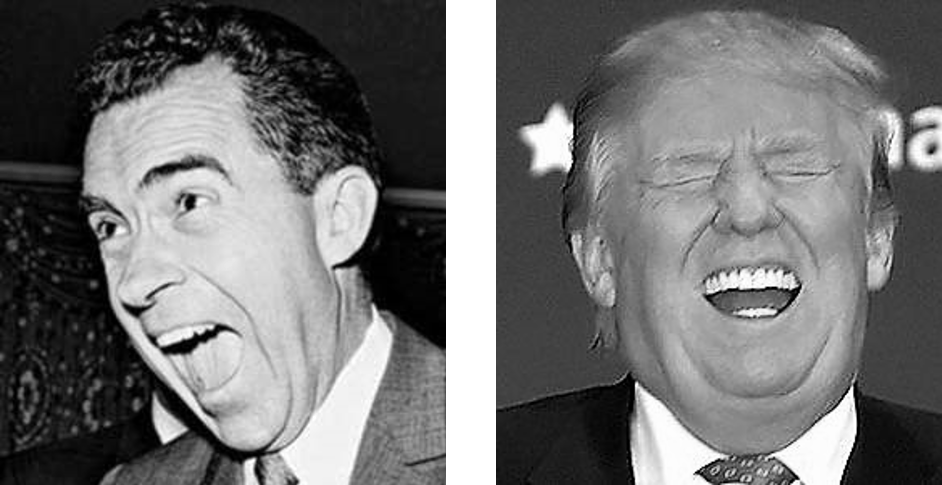
LOL.
This is exactly the budget that Trump wanted. Please, please don't throw me in that briar patch!
You know, we spend a lot of time here at Epsilon Theory with Natural Language Processing (NLP) engines that allow us to visualize the narratives that wash over us like water. I would like to show you a visualization of the US budgetary debate narrative. I would like to show you a picture of the fiscal policy narrative and its connection to the investment narratives that swim in the financial markets ocean. There's just one problem.
That narrative connection does not exist.
I mean ... are there occasional articles printed in the national media about the federal budget and the national debt and all that "stuff"? Sure.
But there is essentially zero narrative or linguistic connection between those articles and anything written about financial markets. Our words about markets and investing do not connect to our words about budgets and spending. At all.
I've never seen a less cohesive, less attentive narrative structure.
And I've seen a lot of narrative structures.
Why is this important?
Because THIS is what complacency looks like.
What breaks that complacency?
If Trump is reelected in 2020, I think he pushes forward a $2 TRILLION bond issuance that is fully or partially monetized by the Fed. They'll be called Infrastructure Bonds.
If a Democrat is elected in 2020, I think she or he pushes forward a $2 TRILLION bond issuance that is fully or partially monetized by the Fed. They'll be called Green Bonds.
It's the same damn thing. Because ... once again, with feeling ... They're. Not. Even. Pretending. Anymore.
Does the market go up or down on this? Yes.
We're all MMT'ers now.
You ready for that? I bet you're not.
DISCLOSURES
This commentary is being provided to you as general information only and should not be taken as investment advice. The opinions expressed in these materials represent the personal views of the author(s). It is not investment research or a research recommendation, as it does not constitute substantive research or analysis. Any action that you take as a result of information contained in this document is ultimately your responsibility. Epsilon Theory will not accept liability for any loss or damage, including without limitation to any loss of profit, which may arise directly or indirectly from use of or reliance on such information. Consult your investment advisor before making any investment decisions. It must be noted, that no one can accurately predict the future of the market with certainty or guarantee future investment performance. Past performance is not a guarantee of future results.
Statements in this communication are forward-looking statements. The forward-looking statements and other views expressed herein are as of the date of this publication. Actual future results or occurrences may differ significantly from those anticipated in any forward-looking statements, and there is no guarantee that any predictions will come to pass. The views expressed herein are subject to change at any time, due to numerous market and other factors. Epsilon Theory disclaims any obligation to update publicly or revise any forward-looking statements or views expressed herein. This information is neither an offer to sell nor a solicitation of any offer to buy any securities. This commentary has been prepared without regard to the individual financial circumstances and objectives of persons who receive it. Epsilon Theory recommends that investors independently evaluate particular investments and strategies, and encourages investors to seek the advice of a financial advisor. The appropriateness of a particular investment or strategy will depend on an investor's individual circumstances and objectives.



Comments
There’s no surer way to destroy a nation than to corrupt its currency. I’ll bet many reading this note think that when this destruction comes, they will be able to position themselves to survive if not thrive. But I think Ben is right, we’re not ready. And the manner of corruption and destruction coming our way is not something for which one can prepare.
I read the entire fiat news piece and there was no backup on DJT swallowing anything. More like slurping from the trough, happily increasing all spending. Yay military! Yay everything! The only person quoted was the champion to Truth Justice and The American Way, Marco Rubio, who was quoted as follows: “It’s a tough one to swallow. I get it, no one wants a shutdown and I don’t want to see us going over the fiscal cliff, but it’s just a lot of spending.” We live in a short attention span world of fruit flies, nobody remembers the lessons of history, which doesn’t repeat, but rhymes, apologies to Mr. S. Longhorne Clemens. He’d have a field day with these criminals.
To play devil’s advocate…couldn’t you interpret the lack of a narrative connection between the deficit and investment themes as the market ‘saying’ that it ‘wants’ a huge fiscal stimulus rather than it’s not prepared for it? The government can borrow 30-year money at 0-1% real. It seems a not totally inconceivable outcome that it could invest that money in infrastructure projects earning a higher return. Even if half was utterly wasted, if the other half earned 2% real returns it would be still be a net positive for growth. I guess what I’m saying is maybe the fall in yields is the market’s signal that this kind of action is what’s needed rather than ignoring the possibility that it could happen?
I think it’s a perfectly reasonable position to say that a large infrastructure spend (or large fiscal stimulus in general) is wise, growth-supportive policy and just what the doctor ordered for the real economy. It’s not MY position (in fact I think pretty much the opposite), but that certainly doesn’t mean that it’s wrong! And I agree that the market would LOVE this sort of fiscal spend program, at least in the early days. As the country song goes, “Falling feels like flying … for a little while.”
But from a narrative perspective, I think the crickets indicate only that - a lack of attention. Trust me, you’ll hear this “Infrastructure is Growth!” narrative loud and clear when (if) it gets some serious policy mobilization. My point in this note is that if you wait for the deafening drumbeats before thinking about this and preparing for this, it’s probably going to be too late to do much on it (for either offense or defense) with your portfolio.
Right, there’s no way to be totally sure. I think inflation is a good bet at this point, but that’s about it. I see inflation only as the last resort by the elites to stabilize their system. It’s the last resort because it diminishes the reputation of the money they create, which is the core support for their power.
Many times historically, they have been able to avoid inflation, and even where there was inflation, avoid devaluation against non-state money. Think how the pound was never officially devalued against gold from the Bank of England’s founding in 1690 all the way to the 1930s. The means at the elites’ disposal are varied, unpredictable and powerful. I also think you could easily argue World War I was just a way to transfer the global banker role from Britain to the US, while destroying Germany’s hopes to take the role or interfere with its power. Thankfully, post-1945, war among major powers has been impossible without destroying the world.
At this point, I just don’t see any way out but inflation and devaluation. Of course, something totally out of left field could happen, but you can’t place a bet on that. Another sign is the fracturing of the political theater into extremist policies. This is interesting, because the top elites want something to blame, other than the core nature of their system. So ‘crazy’ Democratic left-wingers will take the blame for MMT/inflation/anything else that comes of it. And since a deflationary financial bust (before the inflationary reset) will have the effect of lessening the degree of inflation necessary to stabilize the system, ‘crazies’ on the other side of the aisle will help too (e.g. Trump, Powell when he positioned himself for tightening,) in the same way.
Wonder if the losers in the EU will consider issuing megabonds at negative yields to replace their existing bonds. Something like a 50 year bond with a negative 2% coupon. Hey, the debt became self-clearing….after 50 years, no debts !
That suggestion is so insane, I’m wondering now why it hasn’t been put into use yet. It would really be cool if the printer of the money & the user of the money were the same entity! Oh wait…
Unfortunately, debt and deficits are not a problem until they suddenly become one. As long as U.S. Treasuries provide a positive nominal – not to mention real – return, the game will likely keep going. There are $13 trillion of negatively yielding securities in the world. The US looks like a good deal by comparison.
Question for the authors. Wood McKenzie released a report saying it would cost 4.5 trillion to neutralize the US carbon footprint. Why woudn’t Trump issue that in 100 year bonds and clean up the US?
The ONLY reason he wouldn’t do that is that I don’t think he believes in the science, and it would require him to adopt too much of the Green New Deal language.
Continue the discussion at the Epsilon Theory Forum...