
So What, Now What?
September 2, 2025·44 comments

Back in April, I wrote a note called Crashing the Car of Pax Americana. The skinny of that note is that we’re experiencing a regime change across pretty much every policy dimension, not just trade policy and immigration/labor policy, but also monetary policy, fiscal policy, foreign policy, antitrust policy, internal security policy, public health policy … you name it … in the transition to what this administration calls its America First program. You may think that this transition is a good idea or (like me) you may think it’s a disastrous idea, but arguing about that isn’t my point here.
My point here is that the America First regime change IS, that the water in which we swim for every policy dimension has shifted not just in degree but in kind, and that every policy dimension has moved to a new set of equilibrium behaviors and a new set of rational expectations going forward.
Our foreign policy has shifted from an essentially unipolar world where the United States maintained global soft power and an unquestioned reserve currency to finance its standard of living in exchange for ‘free rider’ benefits for our allies, to a multipolar world where the United States has dramatically downsized its third world influence and seeks to extract economic rents from everyone, especially our allies.
Our fiscal policy has shifted from a Congressionally-led (or at least highly mediated) process of budgeting, appropriations and debt ceilings to a Presidentially-mandated process of executive orders, rescissions and directed investments, with $5 trillion in headroom for unfettered deficit spending.
Our monetary policy has shifted from determining bank regulation and interest rates by a quasi-independent central bank per its ‘mandates’ for price stability and full employment to a determination by the White House per its ‘strategic vision’ for managing the deficit and spurring home buying.
Again, I’m not arguing the merits or demerits here. I’m arguing that America First is a nonlinear break from the past, and more to the point, it’s a stable, self-sustaining break from the past. I’m arguing that you cannot unring any of these bells, because that’s what it means to have a regime change and a new equilibrium. I’m arguing that we need to stop pining for policy reversion to some halcyon days of yore (even if yore was just a few months ago) and start planning for the natural consequences of rational government, corporate and household responses to the new regime.
So what, now what?
There is an intense and innate human desire to ‘return to normal’ after a prolonged shock to the system. You see it in families hit by a long illness for a loved one. We all experienced that feeling coming out of Covid. Believe me, I get it. But there’s no going back to what we once considered ‘normal’ for our predictable patterns of interaction (that’s the definition of a regime, btw) with the US government. What we are experiencing today IS our new normal, not just for the next 3 years but for substantially longer as future American Presidents must maintain the structural executive power of the new policy regime even as they make alterations on the surface and at the margins. It’s like the introduction of mustard gas in WWI; once one side uses it, regardless of which side uses it, everyone must use it – at least until a new deterrence equilibrium is established – and it never goes away as a permanent feature of the battlefield.
There’s no going back to ‘normal’ with, for example, the US government’s equity stake in Intel, any more than there’s a going back to ‘normal’ with the Fed’s balance sheet and its purchase of hundreds of billions of dollars in mortgage-backed securities. Once you take an action like this you quickly find that it is impossible to unwind it without causing all sorts of new headaches and without (gulp!) reducing your institutional and bureaucratic power. And even if you do unwind this particular action, you’ve already proven that you are capable and willing to take this sort of action. To use a sports truism here, the first time a player takes himself out of a game or tournament is never the last time he’ll take himself out of a game or tournament, and everyone involved – coaches, teammates, bettors – will adjust their forward expectations accordingly.
Not only is there no going back to ‘normal’ with the US government’s equity stake in Intel – or the revenue cut from Nvidia or the domestic manufacturing demands of Apple or the ‘DEI settlements’ with major law firms or the ‘libel settlements’ with major media companies or the ‘antisemitism settlements’ with major universities – but the clear and obvious implication is that we have yet to settle on the new equilibrium position of direct public sector ownership and control of the private sector. Forget about a reversion. Hell, forget about a slowdown. For at least the next three years, there’s going to be an acceleration in demands for equity and money and rents of all sorts from anyone subject to US government regulation and taxation or anyone who has received US government support, no matter how long ago and no matter how indirectly. I mean, just in the past week, the White House has talked about imposing ‘intellectual property’ settlements on research universities for past research grants and requiring equity stakes and/or revenue cuts from defense contractors who sell weapons abroad. There’s going to be more of these demands for direct public sector ownership and control of the private sector, and not just more of these demands but MOAR of these demands, across every conceivable economic and social dimension.
There’s another word for direct public sector ownership and control of the private sector, of course, and that’s socialism. You could use other -isms here if you like, particularly the f-word to reflect the incestuous marriage between statism and corporatism, and on that note I’m just going to drop this here, as the kids would say.
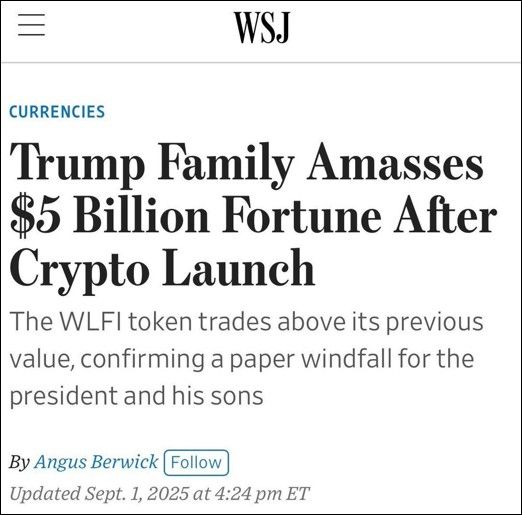
But I’m going to use socialism because people lose their minds when you use the f-word. But regardless of which word you use, what it means to say that this is a regime change and a new equilibrium and there’s no return to ‘normal’ is that direct public sector ownership and control of the private sector is not a temporary side effect of America First on the way to some new capitalist dawn. Socialism IS the outcome.
Ditto there’s no return to ‘normal’ when it comes to tariffs. Protectionism and high tariff barriers are not a White House negotiation tactic on the way to a world of free trade. Protectionism IS the outcome.
Ditto there’s no return to ‘normal’ when it comes to monetary policy. The overt politicization of the Fed and its subordination to White House demands for artificially low interest rates (aka ‘financial repression’) are not regrettable but necessary steps on the way towards reducing the state’s control over the economy. Financial repression IS the outcome.
I mean, you can continue to argue that this isn’t really [insert -ism here] if you want. You can continue to argue that ‘it would be even worse’ with the other side if you want. You can continue to argue about who ‘started it’ if you want. But I’m done with that.
I am delighted to stipulate to my red-oriented readers that the Democrats ‘started it’ when it comes to lawfare, with the preposterous and obviously politically motivated New York state prosecution of Donald Trump. Ditto the politically motivated 0.5% interest rate cut before the election last year. Ditto the personal and corrupt use of Presidential pardons by Joe Biden. Ditto the politicization of the CDC and the political pressure to fast-track mRNA vaccines and the promotion of Fauci’s ‘noble lies’ and the lockdowns to ‘flatten the curve’ by … oh wait, that was Trump … but sure, I am more than happy to stipulate that Biden did exactly the same thing.
And I’m not asking anyone to give up their righteous anger at whoever and whatever they are righteously angry about, least of all myself. Personally speaking, I will never not be angry at an American President who sends badge-less, warrant-less, armed and masked agents to grab people off the street and detain them indefinitely for the probable cause of having brown skin. Or an American government that has established its very own Gulag Archipelago – not in Siberia but in El Salvador and Uganda and the Everglades and the Chihuahuan Desert – where cruelty is the obvious point and punishment exists for punishment’s sake. To a lesser but still very real extent, I will never not be angry at the venally corrupt, vacant, egomaniacal, figurehead former President and the courtiers inside and outside the White House who propped him up for years, projecting nothing but weakness and achieving nothing but the accelerated collapse of Pax Americana.
But I am asking all of us – myself included – to set aside the anger long enough to look clearly at what IS, not what either our anger would have us project or what our innate desire for a return to normalcy would have us imagine.
So what, now what?
I’m asking this because I think that I see what IS when it comes to the current gerrymandering efforts in Texas and in California. I think I see what the new set of equilibrium behaviors and rational expectations are, and it scares me even more than the socialism, protectionism and financial repression that are similarly part of today’s IS. I’d like to ask readers to figure out where I’m wrong and how we can avoid what seems to me to be the most likely outcome of this game.
As I see it, the naked off-cycle gerrymandering of Congressional districts for direct partisan benefit happening today isn’t just a good analogy for the mustard gas example of how an equilibrium shifts, but actually IS mustard gas in our modern political trench warfare.
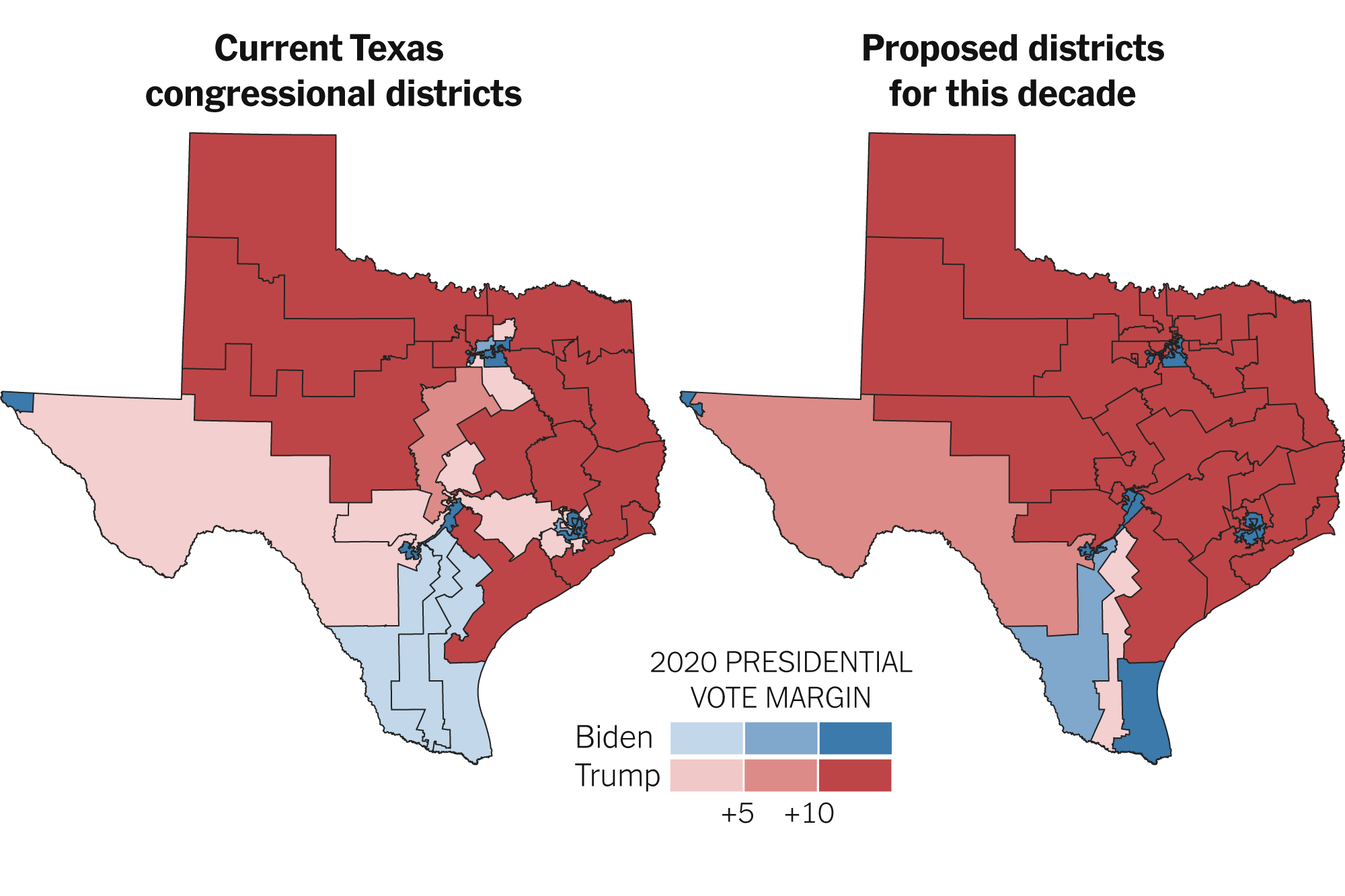
At the request and encouragement of the White House, Texas is creating new Republican districts without even a fig leaf of a non-partisan rationale. They are explicitly creating new Republican-majority districts to marginally disenfranchise Democratic voters because they can. To which California, which has in the past created Democrat-majority districts to marginally disenfranchise Republican voters (but with a fig leaf of a non-partisan organization to manage the process), will respond by abandoning the fig leaf and creating new Democrat-majority districts because they can. To which other red states like Florida will respond by creating new Republican-majority districts. To which other blue states like New York will respond by abandoning their fig leaf of an independent electoral districting commission and creating … well, you get the idea. It’s mustard gas. Once one side uses it, regardless of which side uses it, everyone must use it.
My strong belief is that if the Republicans come anywhere close to losing the House because of Democratic Representatives from newly gerrymandered districts, Trump will declare those new Democratic members-elect in the 2026 midterms to be ‘illegitimate’ because of an ‘illegal’ state process (like abandoning the fig leaf of an independent electoral districting commission). And while the federal government has next to no Constitutional role in certifying Congressional elections or members-elect, I think there’s a pretty straightforward way that Trump could orchestrate a contested seating of the 120th Congress and force it to a Supreme Court decision.
The Constitution requires members-elect to take an oath of allegiance to the Constitution before they can assume office, but is silent on how or by whom that oath is administered. Federal law says that oath can only be administered to members-elect by the (new) Speaker of the House, but in the scenario I’m imagining both the Democratic caucus and the Republican caucus would take steps to elect a Speaker of the House for the 120th Congress, and neither caucus would recognize the other Speaker-elect as legitimate. We know who the White House would recognize! I know this scenario sounds crazy, but this is a pretty well-known rabbit hole that came up in the 118th Congress when the Republican caucus took several days to elect a Speaker and no one had actually taken their oath, and it’s certainly no less crazy than Trump’s Jan 6th premise that Mike Pence as presiding officer of the Electoral College could reject entire slates of electors on suspicion of ‘illegitimacy’.
Yes, the Supreme Court would eventually weigh in here, and I think they’d rule that a) the federal law requiring an oath administered by the Speaker of the House does not apply if it runs afoul of the Constitution, which in addition to requiring an oath also sets a date certain for the new Congress to take office, b) that if the law doesn’t apply than anyone – like a local notary, even – can administer the oath, and c) since the federal government has no say – none! – over state certification of Congressional members-elect, then the Democrats in this scenario would have the legitimate claim to a majority caucus and control of the House. But honestly, who knows how they’d rule!
More to the point, the Supreme Court can’t rule on this until it actually happens, so there would be a period of time in January 2027 where we would not have a 120th Congress at all. More crucially still, no matter how the Supreme Court ruled, broad swaths of the American electorate and one of the two most powerful executives in the country (the US President and the governor of California) would have very publicly rejected the legitimacy of the 120th Congress. At a minimum every state would take immediate action to disenfranchise its minority party voters to the nth possible degree in advance of the 2028 election, but I don’t think there’s any possible way that we’d even get to the 2028 election. Federalized National Guard units would already be deployed into major blue state cities as part of the federal crime bill that’s going to be enacted this fall, and do you think Trump would hesitate for one second to invoke the Insurrection Act? I don’t.
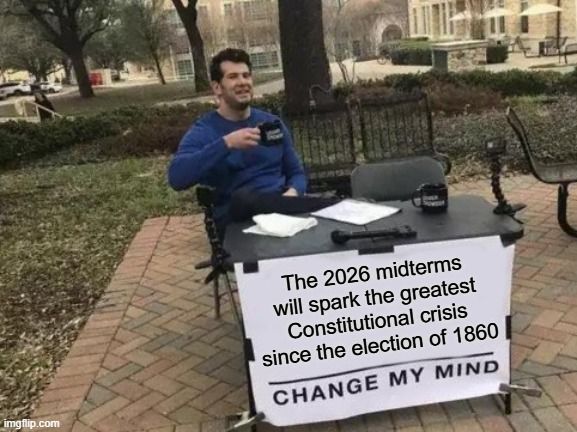
I have absolutely no idea what the offramp is for the scenario I’m describing. Granted, I’m assuming that it’s close in the House, because how could it not be? There’s no way that Trump doesn’t lose some GOP seats in the midterms, and that’s what the whole Texas gerrymandering effort is trying to make up for. But maybe Trump stands down if there are so many midterm GOP seat losses that the House flips convincingly regardless of the California gerrymandering efforts? I dunno, that sounds like wishful thinking. But I can’t think of anything else. And I’m really serious about asking readers for their ideas on an offramp. Please!
Because I’ll do anything to avoid this:

But I’m really not sure that we can.
I used that image from the movie Civil War for a note I wrote last summer, titled This is the Great Ravine, a phrase taken from Cixin Liu’s Three-Body Problem science fiction trilogy, where he describes a 50-year period of immense social upheaval, destruction and (ultimately) recovery across the globe. In that note and many others, I’ve talked about our winding path down into the Ravine, sometimes steep, sometimes shallow, sometimes even with a tantalizing move upwards where you can maybe see a little more sky up over the canyon walls. In fact, I’ve been talking about the path and process of going into the Ravine for nine years (!), going back to September 2016 (Virtue Signaling, or Why Clinton is in Trouble) when I wrote that a) I think Trump beats Clinton, and b) I think Trump breaks us because he changes the equilibrium of every policy dimension in the country.
More importantly than what happens in any of these international games, however, is what happens in our domestic games. Blowing up our international trade and security games with Europe, Japan, and China for the sheer hell of it, turning them into full-blown Competition Games … that’s really stupid. But we have a nasty recession and maybe a nasty war. Maybe it would have happened anyway. We get over it. Blowing up our American political game with citizens, institutions, and identities for the sheer hell of it, turning it into a full-blown Competition Game … that’s a historic tragedy. We don’t get over that.
I don’t think people realize the underlying fragility of the Constitution — the written rules to our American political game. It’s just a piece of paper. Its only strength in theory is our communal determination to infuse it with meaning through our embrace of not only its explicit rules, but also and more crucially its unwritten rules of small-l liberal values like tolerance, liberty, and equality under the law. Its only strength in practice is that whoever runs our Executive branch, whoever is our Commander-in-Chief, whoever is in charge of “law and order”, whoever runs our massive spy bureaucracy national intelligence service, whoever controls the legitimate use of deadly force and incarceration … that he or she believes in those unwritten rules of small-l liberal values like tolerance, liberty, and equality under the law. When you hear Trump talk about “loosening the law” on torture, or “loosening the law” on libel prosecutions of anyone who criticizes HIM, or the impossibility of a federal judge being able to rule fairly because his parents were born in Mexico … well, there’s no way he believes in those small-l liberal virtues. No way.
Virtue Signaling, or Why Clinton is in Trouble (September 29, 2016)
Nine years ago. That’s when we started down this path into the Great Ravine. I don’t think we’re on the path anymore. I think we’re there. Maybe we don’t recognize that we’re already there and it takes something like a failure of the 120th Congress to make us see it, but we’re already there.
American socialism IS. American protectionism IS. American financial repression IS.
The Great Ravine IS.
DISCLOSURES
This commentary is being provided to you as general information only and should not be taken as investment advice. The opinions expressed in these materials represent the personal views of the author(s). It is not investment research or a research recommendation, as it does not constitute substantive research or analysis. Any action that you take as a result of information contained in this document is ultimately your responsibility. Epsilon Theory will not accept liability for any loss or damage, including without limitation to any loss of profit, which may arise directly or indirectly from use of or reliance on such information. Consult your investment advisor before making any investment decisions. It must be noted, that no one can accurately predict the future of the market with certainty or guarantee future investment performance. Past performance is not a guarantee of future results.
Statements in this communication are forward-looking statements. The forward-looking statements and other views expressed herein are as of the date of this publication. Actual future results or occurrences may differ significantly from those anticipated in any forward-looking statements, and there is no guarantee that any predictions will come to pass. The views expressed herein are subject to change at any time, due to numerous market and other factors. Epsilon Theory disclaims any obligation to update publicly or revise any forward-looking statements or views expressed herein. This information is neither an offer to sell nor a solicitation of any offer to buy any securities. This commentary has been prepared without regard to the individual financial circumstances and objectives of persons who receive it. Epsilon Theory recommends that investors independently evaluate particular investments and strategies, and encourages investors to seek the advice of a financial advisor. The appropriateness of a particular investment or strategy will depend on an investor's individual circumstances and objectives.

Comments
The fracture we are witnessing feels inevitable. It happened the moment a man was chosen for saying he’d go back to the past, “Make America Great Again!” not some hopeful utopia, but nostalgia. The past however, was/is bitter for some people and not so sweet as remembered by this man. He wants to go back to clearly tiered systems, one for the rich, one for the poor, one for the whites, one for the non-whites, one for the winners and none for the losers. His aspirations are pure capitalistic in nature, even if the vehicle of exploitation can be considered socialist in nature, though my preference is closer to big bad F- word. The outcome now is no aspiration but self aspiration. No power but my power. Your government body my presidential choice.
So people fight back, because who wouldn’t fight back in that scenario? When fighting back doesn’t look proportional, that is when escalation can happen more quickly as justification is gained and that will speed up the deterioration. So this is truly the ravine- a reflexive distancing being created by actions no one has any power over. Everyone just struggling to survive.
But while it’s true it looks bleak, it’s also good to remind ourselves people are still people and not the unclear shadows on the other side of the ravine.
Personally one thing that has given me slight hope, was the shoddy parade given by the American miltiary for his birthday. While I am not American I was proud of the soldiers for that display. Their casual defiant attitude belies the underlying mess that is our democracy, everyone is an unruly angry presence and while we struggle to work together, the underlying message can still be shared in solidarity. It wasn’t a well crafted message of defiance, but it got the job done better in my opinion because of that.
I mean it’s truly funny that one of the richest man in the world, one of the most powerful man in the world, can’t cobble a group of people together to give him one of those synchronised goose-step display any 3rd world tinpot dictator could snap his finger for. Maybe that’s an exageration, but it was funny non the less and a show of unruliness of the miltiary, that they are capable of disobey an immoral order.
I am not sure what sort of ravine this will be, but this gives me hope it will be a disorganised display- like a clown show- because that was the resistence the people were capable of displaying, which limits the amount of damage that can be done. A comical hope for an ineffective government, ironic in nature.
Are you talking about a real moment or an imagined one?
A date or a fig ment?
I appreciate the note (and the energy it takes to write this kind of note).
When I was deeply involved in the world of innovation, a new idea (or solution, product, program, etc) would come along and get presented to an audience (ie decision makers, buyers, investors, etc). An early reaction of the “audience” (especially those less versed in the world of innovation) was to try and put the new thing into an already established, well understood category. “Oh, it’s like this.” or “This is one of those.” Sometimes that worked okay. Often it didn’t. Often the old categories didn’t fit at all. A new mental model (paradigm) was required. Trying to match the new thing to an old category ultimately slowed down adoption.
I think that is part of why I like the framing of what this IS using the Great Ravine. (The other part is that I loved the trilogy and Dark Forest was my favorite of the three). It matters less what sort of -ism is active in a Great Ravine. What matters a lot is how bad things are; how bad they will get; and how excruciatingly long those bad things will last.
That said, I do think there is value in correctly defining what this is, be it fascism, authoritarianism, socialism, or some new term-ism. Yes, time - and stuff getting a lot worse - will help society apply the appropriate label. When that happens . . . history will not be kind.
It’s imaginary I think. But the slogan says “again”, so the nostalgia is real because nostalgia is based on memory, it doesn’t have to be true.
The word “nostalgia” was first used in 1688 by Swiss physician Johannes Hofer in his medical dissertation to describe a pathological form of homesickness, a disease he linked to the pain of separation from home, particularly among Swiss mercenaries. Derived from the Greek words nostos (homecoming) and algos (pain), the term was initially a medical diagnosis for the severe symptoms experienced by soldiers far from their native land.
Emotional memory is a powerful force.
we’ll take a cup of kindness yet,
for auld lang syne.
Great note, and right on to describe the IS.
Solutions? I do not think any solution directly using our governmental structure works. Any scenario you laid out ends in some sort of Civil War or a totalitarian regime.
The only solution I see that could break us out of the Ravine into a good place is mass marches and movements. Congress and the Judiciary are sensitive to public opinion. If/when they see the mass of Americans grossly unhappy with the new order, they will allow that New Order to be negated.
Yes, the other side of the Ravine will not be like our past. But maybe we can carry over most of he Bill of Rights.
Would this work? I would contend we climbed out of the ravine about the time of Nixon, in part, was because of awareness created by people in the streets.
Off-ramp? The Titanic can’t have an off-ramp. But we can damn well build lifeboats. And we can build them with an “Ark” to carry the seeds of a freer, more human future a “Compass” to steer.
We are not headed back to “normal.” The old order has already shifted into a new equilibrium of state control, protectionism, and financial repression. Like the Titanic after striking the iceberg, the system is too large, too brittle, and moving too fast to turn away. There is no off-ramp.
But collapse is not the end. Just as the Flood is a recurring story across human civilization, so is survival and renewal. Our task is not to deny the storm or to pine for calmer seas — it is to steer by the Compass and build Arks that carry forward what matters most.
We may not be able to avoid the crisis; history has entered its Fourth Turning. But we can choose whether it becomes an uncontrolled wildfire or a controlled burn that clears space for renewal. That choice rests on whether we prepare now: preserving knowledge, building resilient infrastructure, shaping stories of sacrifice and rebirth, and connecting Arks into a living network.
I find it odd. Well actually I don’t find it odd that, after what the Democrats have done to Trump over the past 8 years that totally rejected any concept of norms, you can’t imagine them pulling another stunt if it looks like they aren’t going to regain the House. They have a few hundred judges thst seem willing to do anything thry want, including ignoring the Supreme Court l
One of the many reasons I object to all of this is precisely because I believe it will—not would, will—be worse when the other side does it. I really don’t like the Trump flavor of state capitalism, and I’m going to absolutely hate the Ocasio-Cortez version even more.
I’m in agreement with the main thrust of this article and believe that the “game” has fundamentally and irreparably changed in the U.S. However, as a pessimist by nature, I find it helpful to challenge my negative biases by thinking about what might go right, or what unforeseen circumstances could bend the arc of history in a more constructive direction.
From this perspective, my mind gravitates toward some sort of galvanizing event—a major west coast earth quake, or a hurricane event of a magnitude similar to Andrew or Katrina—that proves the worth and need for a functioning government (and immigrants in the construction sector). In other words, an event that reveals the pitfalls of the “performative” governance that has come to define the U.S. system.
Even under such a scenario as outline above, it’s difficult to be optimistic and hopeful when I look at the analog of Covid. In the initial stages of covid, I thought a global/national health disaster might function as a binding agent for society—a cause to rallying around.
How wrong that line of thinking was to prove.
As a result, I’m far from certain that another domestic catastrophe would spur the degree of change now required to return the U.S. to a more collaborative form of politics, but there’s a chance.
Continue the discussion at the Epsilon Theory Forum...