
Prophet of the Pandemic
August 26, 2021·14 comments·In Brief
Luke Burgis wrote a book that I think is really good. It's called Wanting: The Power of Mimetic Desire in Everyday Life, and we recorded a podcast to talk about it. Luke has graciously agreed to contribute an occasional essay to Epsilon Theory, and there's lots more great stuff where this came from on Luke's substack: Anti-Mimetic.
Luke has co-created and led four companies in wellness, consumer products, and technology. He’s currently Entrepreneur-in-Residence and Director of Programs at the Ciocca Center for Principled Entrepreneurship where he also teaches business at The Catholic University of America. Luke has helped form and serves on the board of several new K-12 education initiatives and writes and speaks regularly about the education of desire. He studied business at NYU Stern and philosophy and theology at a pontifical university in Rome.
As with all of our guest contributors, Luke’s post may not represent the views of Epsilon Theory or Second Foundation Partners, and should not be construed as advice to purchase or sell any security.
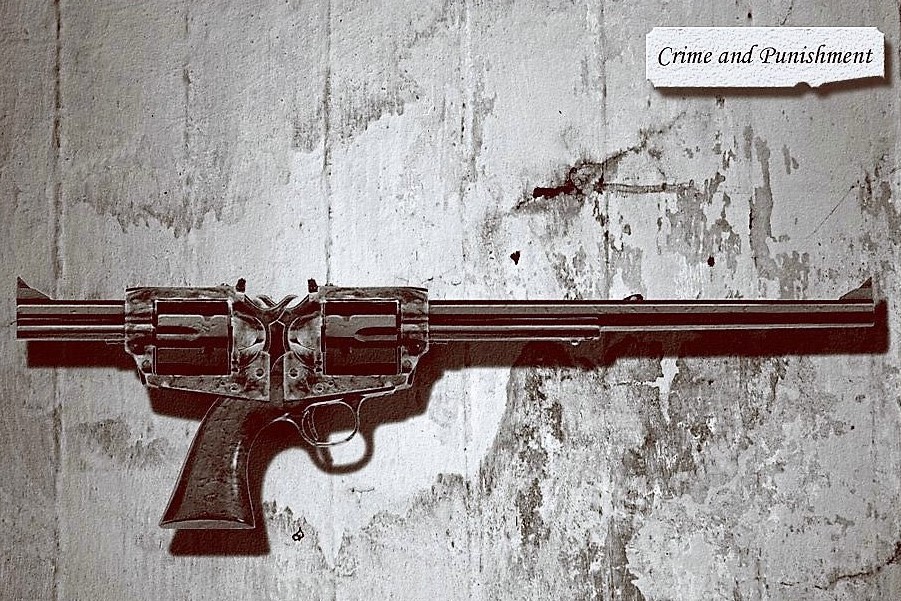
George Grie, Crime and Punishment (2006)
The Truth about Plagues
René Girard spent a large part of his career studying plagues and pandemics in ancient literature. He noticed something fascinating: in every instance, the psychological contagion that spread fear and anxiety and led to faction-forming is inseparable from the microbial and infectious contagion that caused a health crisis.
In fact, the word most frequently used for “plague” in ancient Greece (in both Sophocles and Thucydides) is nosos, which simply means “sickness.” When there is a civil war between Greek cities, it is described as a nosos. Likewise, the plague that devastates Thebes in the famous story of Oedipus Rex is a nosos.
Isn’t it also interesting that the case of the plague in Thebes is attributed to the breaking of social taboos by Oedipus? He killed his father and married his mother. For this social transgression, Oedipus caused a microbial infection. He must be killed or banished from society so that the plague will end.
For centuries people have read this story (and many others like it) as fanciful mythologies—what silly, pre-scientific people they were, attempting to put an end to a plague by punishing incest!
But what the Greeks knew—perhaps even better than we do—is that the disruption to the biological order and the disruption to the social order are one and the same.
Nothing has changed. Human nature remains the same. If anything, our perceived mastery over nature and our technological advancements have only bolstered our pride and our blindness to the psychological, social, and spiritual sickness that will last long after the virus is under control.
If we had even one measure of competence in anthropological and social issues—an understanding of basic features of humanity—for every 10 measures of scientific study and epidemiological press conferences, we’d be in far better shape. As it stands now, though, the pandemic is still seen primarily through a materialist lens without eyes to see the people, in the fullness of their humanity, who are struggling to make it.
If you’d like even a minor glimpse into the depth of that problem, here is a reply left on a YouTube video that featured a piece of classical music.

What we are witnessing is a breakdown in human relationships.
René Girard, reflecting on the book Crime and Punishment by Fyodor Dostoevsky, took particular note of a frightening dream that one of the main characters has near the end of the novel. “Raskolnikov has a dream during a grave illness that occurs just before his final change of heart, at the end of the novel,” writes Girard. “He dreams of a worldwide plague that affects people’s relationship with each other. No specifically medical symptoms are mentioned. It is human interaction that breaks down, and the entire society gradually collapses.”
Girard saw a prophetic voice in Dostoevsky, the great novelist, who in the following passage (written in 1866, long before the Spanish Flu even came to pass) is describing what is essentially a mimetic crisis: the breakdown of a society when nobody knows who to trust, nobody knows who to imitate (because there are no more shared models: everyone is a little Cartesian god who decides for himself), and any form of coordinated action is rendered impossible.
Here is the passage in full, which is worth reading slowly:
"He dreamt that the whole world was condemned to a terrible new strange plague that had come to Europe from the depths of Asia. All were to be destroyed except a very few chosen. Some new sorts of microbes were attacking the bodies of men, but these microbes were endowed with intelligence and will. Men attacked by them became at once mad and furious. But never had men considered themselves so intellectual and so completely in possession of the truth as these sufferers, never had they considered their decisions, their scientific conclusions, their moral convictions so infallible. Whole villages, whole towns and peoples went mad from the infection. All were excited and did not understand one another. Each thought that he alone had the truth and was wretched looking at the others, beat himself on the breast, wept, and wrung his hands. They did not know how to judge and could not agree what to consider evil and what good; they did not know whom to blame, whom to justify. Men killed each other in a sort of senseless spite. They gathered together in armies against one another, but even on the march the armies would begin attacking each other, the ranks would be broken and the soldiers would fall on each other, stabbing and cutting, biting and devouring each other. The alarm bell was ringing all day long in the towns; men rushed together, but why they were summoned and who was summoning them no one knew. The most ordinary trades were abandoned, because everyone proposed his own ideas, his own improvements, and they could not agree. The land too was abandoned. Men met in groups, agreed on something, swore to keep together, but at once began on something quite different from what they had proposed. They accused one another, fought and killed each other. There were conflagrations and famine. All men and all things were involved in destruction. The plague spread and moved further and further. Only a few men could be saved in the whole world. They were a pure chosen people, destined to found a new race and a new life, to renew and purify the earth, but no one had seen these men, no one had heard their words and their voices."
Fyodor Dostoevsky, Crime and Punishment (1866)
No coordinated action is possible in this situation—but uncoordinated and spontaneous action is. Throughout history, Girard discovered that this uncoordinated and spontaneous action has most often taken the form of the scapegoat mechanism: someone or something is singled out as the cause of the problem. The community united against them in order to save themselves from themselves. It’s a form of religious sacrifice that brings order out of chaos.
We are already headed quickly in this direction, but it’s not too late to turn back.
DISCLOSURES
This commentary is being provided to you as general information only and should not be taken as investment advice. The opinions expressed in these materials represent the personal views of the author(s). It is not investment research or a research recommendation, as it does not constitute substantive research or analysis. Any action that you take as a result of information contained in this document is ultimately your responsibility. Epsilon Theory will not accept liability for any loss or damage, including without limitation to any loss of profit, which may arise directly or indirectly from use of or reliance on such information. Consult your investment advisor before making any investment decisions. It must be noted, that no one can accurately predict the future of the market with certainty or guarantee future investment performance. Past performance is not a guarantee of future results.
Statements in this communication are forward-looking statements. The forward-looking statements and other views expressed herein are as of the date of this publication. Actual future results or occurrences may differ significantly from those anticipated in any forward-looking statements, and there is no guarantee that any predictions will come to pass. The views expressed herein are subject to change at any time, due to numerous market and other factors. Epsilon Theory disclaims any obligation to update publicly or revise any forward-looking statements or views expressed herein. This information is neither an offer to sell nor a solicitation of any offer to buy any securities. This commentary has been prepared without regard to the individual financial circumstances and objectives of persons who receive it. Epsilon Theory recommends that investors independently evaluate particular investments and strategies, and encourages investors to seek the advice of a financial advisor. The appropriateness of a particular investment or strategy will depend on an investor's individual circumstances and objectives.
Comments
Is it likely that a generation that refuses to learn from recent history of Marxism in practice, Mao, Xi, Castro, Chavez, etc. is going to have an ability to learn from Sophocles ?
I think your cynicism at the generational level is an interesting one, but which generation are you referring to?
I have found the Fourth Turning (Howe & Strauss) theory to be applicable in so many ways recently. The transition to the world of GenX/Millenials (the prophetic “Nomad/Hero” cycle in the theory) from the Boomer/GenX (“Prophet/Nomad”) will certainly lead to different perspective, and IMO a positive change.
I agree Fourth Turning is relevant. Unfortunately we are at the point in that model that almost always results in war or global war. Firebomb current structures into oblivion and lay the groundwork for some new way. Accompanied by great financial upheavals, lots of losers, and a few winners. Such was the previous turning point after WW2, and then after US Civil War before that. Chinese would strongly prefer to win the next WW without firing a shot. They have an excellent start on achieving that objective since most in the West don’t even realize we are already at war with China. Or at least China is at war with the West, on a very intentional course and executing a strategy they talk about openly. They’ve given us their war manuals in fully open form, The Art of War, and few pay attention while they execute both strategy and tactics with precision and persistence. They play the long game. The average attention span in the West is roughly that of a gnat, and so our long game consists of listening to a five minute news piece, instead of a 10 second sound bite. We’ve become weak as a society. In the West we spend time dithering on the truly important questions like - what bathroom are you allowed to use? Not sure the “good guys” are going to be victorious in the current Fourth Turning, unless you think the Chinese are the good guys, as John Cena clearly does.
Generational cynicism is hard to focus on any single age group, since thought leader Bernie clearly doesn’t fit into the GenX or Millenial cohort. We are an overly entitled society where far too many are illogically risk adverse, don’t want to be accountable for living their own life, are willing to trade their freedom for security, and will ultimately get neither.
We could be less than 20 years away from being as free and prosperous as Cuba.
Thucydides knew it, too. A Pack member reminded me of this great passage from The Peloponnesian War …
Notice that an accompanying activity during these breakdowns in order (in politic and thought) is the rise of a “new” or “reformed” religion. Religions provide a sense of continuity and stability to a broken down society.
“For what do you hunger, Lord?” Moneo ventured.
“For a humankind which can make truly long-term decisions. Do you know the key to that ability, Moneo?”
“You have said it many times, Lord. It is the ability to change your mind.”
“Change, yes. And do you know what I mean by longterm?”
“For you, it must be measured in millennia, Lord.”
“Moneo, even my thousands of years are but a puny blip against Infinity.”
— God Emperor of Dune
Playing the long game is indeed key. But even the CCP’s horizon is too short.
Reactions to the Delta variant have been very telling. I’ve heard thoughtful people say “they lied to us” meaning they believe they were told that the vaccine was a magic bullet and they no longer had to worry about the plague. Of course nothing could be further from the truth; the data always showed there would be breakthrough cases and the health experts have warned about variants from day one. Perhaps Biden can be blamed for announcing victory by July 4. In retrospect that was clearly a mistake and a big factor in the current mistrust of his administration. The reality is that everyone desperately wanted to hear that message and would have done so even if Biden had said “things seem better, but we need to stay vigilant”. It’s the phenomenon that brings gawkers out in the eye of the hurricane only to be blown away by the oncoming storm that they’ve been warned is coming on the other side. Even today, when the opposite eye wall is here, many are claiming that the virus is not dangerous to unvaccinated children. Things are not as we imagine just because we want them to be, but self-delusion is apparently core to our nature.
A Pack member sent this comment to me for posting because he wishes to remain anonymous. I think it’s full-hearted and well-put, and reflects a reality of our world that gives the lie to the intergenerational sniping and snarking that is everywhere today … even here on the Forum. - Ben
There was a comment on ET that hit a nerve.
As a card-carrying Gen Z (born after 01/01/1997) I feel I need to respond.
I have, so-far, worked in two corporate gigs, and am about to start at a third, I have always been the youngest and had jokes made about my generation, usually that we’re lazy or don’t know something from the 70’s/80’s/90’s.
With the age gap vs my directors being so large I have acted as an IT support person and a lot of the time someone to discuss politics/society trends with. One thing that seems to come up is why is my generation so left leaning/woke, did we not see what happened with Russia, and Venezuela now?
We did. We see it, and most of us don’t want that future.
But what we see now, and in the past is scary and scares us for our future. Most older folks don’t seem to see that or don’t even want to change.
I am not from the good ol’ USA, but it is clear American Capitalism has failed. Don’t @ me, it’s true. The system does not work for the bottom 50%. In fact, it may be the system doesn’t work for the bottom 80% (maybe 99%).
A truth though is that the USA beat Russia in the cold war. America was more prosperous.
But then something perverse started to happen. The managerial class Ben so aptly raps on about got even richer. American style shareholder capitalism and special interests hijacked whatever was working.
Even in my small part of the Anglosphere, we are impacted by those forces that tries to take away our hard-fought healthcare and social care (thank you trade unions). Labour power everywhere has eroded.
Whilst my generation didn’t sit through the 2000 crash or the GFC/Eurozone crisis, the millennials before us did. And they got it tough, and we noticed. Some of us Gen Z’ers were listening/reading and saw the Occupy Movement.
Nothing seemed to have changed.
But we feel it should.
COVID has worsened these inequities further. I was shielded from losing my job and could work from home. My sisters? My girlfriend? My friends? Nope, they lost jobs, and income or had to work on the frontlines with an unforgiving and rude public. And yet Jeff Bezos got how much in bailout funds for Blue Origin? Ok, maybe he didn’t get the money, but the fact he tried is emblematic of my point.
We are “socialists” as we feel we are being left behind. The data is a little mixed, but it mostly points to our generation, Gen Z and Y, having higher debt, lower incomes, more competition for jobs, and a higher income to house price ratio.
Every entry level job requires three years’ experience. Every step forward is competitive as hell. My grandfather and mother walked into their jobs with their resumes and had them for life. We have artificial intelligence that scans our resume and knocks you out if you did not go to a top tier university.
We also see our standard of living slipping compared to what our parents got.
These are incredibly complicated issues with complex solutions. Way above my paygrade and the scope of this.
But unless you can fix the class-anxiety and standard of living for those that can’t afford to live in an international city, we will trend ever more left. Or even right. We will trend away from what clearly is not working.
I have trended left. And those that make up the white-collar professions and university educated elite seemed to have done the same.
The most conservative millennial couple I know recently became left. They voted no for same-sex marriage, as is their right. But they can’t afford a house. They work hard, a banker and psychologist. But the policies on the right don’t seem to combat that. The policies on the right don’t seem to combat the shit they put up with from their landlord. So, their views trended left. On the left, they seem to care about renters rights and want to fix infrastructure and housing. Stuff the right doesn’t seem to want to discuss.
Most of us did what our parents asked us to do. We worked hard at school, then at university, then at Fortune 500 companies. And what do we have to show for it? For a lot of people, not much. Every bit of money feels like it goes to pay bills rather than into savings, investments, or a mortgage (we pay off our landlords’ mortgages instead).
Fuck that. I am angry.
I am one of the lucky ones. Good family, house in the best suburb, private schooled, top tier uni, good jobs. Learned to invest. In every way I should be shoo-in for the conservative party. But I am not, as I recognise, even as I have worked hard, and educated myself that I am lucky.
As a group, my friends and I aren’t doing too flash. And we see it’s a trend in most social groups of our age.
And then we see tax cuts to the uber wealthy, and profligate spending by hypocritical politicians. We see the corruption, that they don’t even try to hide anymore. We want change. We want better.
If we complain we are branded as lazy or as whiners. Or as a soft generation.
Fuck that.
We are tough. We just have different expectations on how you can treat someone.
I mean, who the hell are you sending to war? It’s not you boomers any more
On average my generation:
We work just as hard (often two jobs or a side hustle).
Yet we feel like we aren’t going anywhere. When we bring it up, we are mocked and it isn’t treated seriously. Yet y’all can’t even use a phone.
That’s why we are trending anywhere but where we have been.
So, if you think this is me on my high-horse whining and complaining, it is. I am lucky enough to do so. But also, we’re tired of the way people treat each other and the left seems to offer ways of organising that treat people better than what is on the right.
To @dj1atlanta, this is us learning from our history and wanting better. We have read books by Marx and Mao, and probably the Thucydides Trap too. We learn.
This all said, the tankies though are a fringe movement. Most want something closer to Denmark than Venezuela. There is a lot you can say about every issue, and how oversimplified this is. (I haven’t even touched on intersectional politics and wokeism) but there is a lot of anger.
Gen Z woke/lefty bloke from Australia.
The comments are well-made and I generally agree with most points. I agree that the GenZ cohort should be angry, upset and unwilling to accept the terms being forced on them by previous generations. The level of generational theft that is currently going on is obscene, as debt is piled on debt by current political leaders, of all stripes, left and right. Fourth Turning is at its heart about a major generational shift, and there is no possibility that GenZ will tolerate for much longer the untenable position the “oldsters” are putting them in. They will rightly demand a new system. They will ultimately get a new system. What will that new system be?
Thinking in traditional terms of political left and right won’t fix the underlying issues in current Western politics, in my opinion.
The fix lies in first identifying root causes of growing inequality.
Which I would lay at the feet of Central bankers in general, and the Federal Reserve in particular, who by policy of fiat manipulation are directly causing asset bubbles, which results in ever widening wealth gaps. The amount of “capitalism” in the US is declining rapidly, and is being replaced with the sinister look-alike twin of crony capitalism. Those that can afford assets like real-estate or stocks are getting fabulously wealthy on paper, and the divide widens. Those that are closed to the Federal Reserve, big money banks, much of Wall Street, make out like bandits as the Fed prints and print and prints, and very little of that printing trickles down.
Have you seen a chart showing Money Velocity over last 10 years?
The Occupy Wall Street group was close to the heart of the issue a decade ago, but their aim was slightly off when they fingered Wall Street itself as the issue, instead of digging one level deeper and going after the Central Bankers and politicians that have enabled Wall Street’s worst behaviours.
I agree with the comments from the GenZ gentleman from Oz, that the current rigged and unfair system is causing a significant shift to the political left by young people. But lurching to the political left has been tried in many places and at many times in the past and has never turned out well. Those politics produce Venezuela. They don’t produce a long-term sustainable version of Denmark.
My thoughts on the solution to cure most ills in current system:
Getting from here to there will be a huge challenge.
1 - have to convince the young generation that is going to define the future that their enemy is not the political right or the free market (capitalism), and their saviour is not the political left or collectivism (communism). Have to convince the younger generation the issue to fix in current broken system is continuous political manipulations of fiat currencies, enabled and perpetuated by Central Banks and current set of politicians (from both left and right).
2 - have to conceive of a way to wrap this entire notion into a short three word phrases that a movement can gather behind (e.g. BLM, OWS, etc.), and find a simple meme that can be used to organize and orchestrate an entire movement of the younger generation to target sound money as the best solution.
“Money Printer Go B’rrrrr” seems like the best anyone has been able to come up with so far.
But that’s not going to be good enough to get a movement to rise up against the evils of Central Banks.
Interesting. I recognize that any one of us can’t know everything about everything and at some point we must defer to others. That aside…
“I’ve heard thoughtful people say “they lied to us” meaning they believe they were told that the vaccine was a magic bullet and they no longer had to worry about the plague.”
I wonder who told them the vaccine was a magic bullet and why they took that on face value. Is it delusion that those thoughtful people preferred to latch onto a magic bullet rather than wanting to raise up their thought game a notch about something so important. Because responding “they lied to us” (they who?) sounds a lot more more like they got nudged (allowed themselves?) into lemming like behaviour. However, to be fair, I also have little doubt that ‘rabbit hole’ search algorithms have exacerbated this problem and perhaps they simply weren’t allowed to find better information.
Unfortunately, I suppose we can all be thoughtful in one area and yet deluded in another. I’m quite terrified about which topics where I am deluded. Worse because I’ll never ever know it because, well I’m deluded.
Continue the discussion at the Epsilon Theory Forum...